
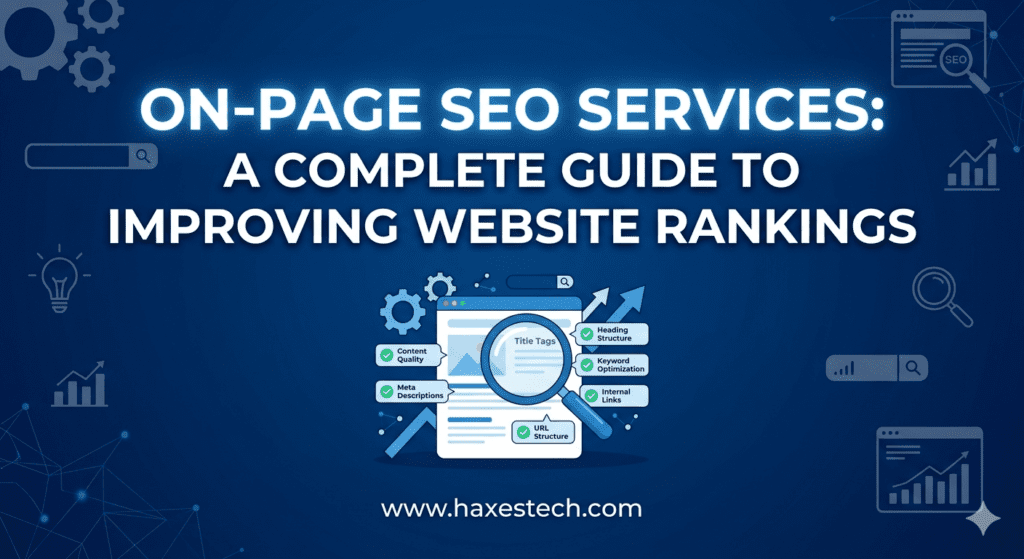
In the modern digital marketplace, simply launching a website and posting a few articles is not enough to get noticed. Many business owners are frustrated because, despite having great products and well-written content, their website stays hidden on the third or fourth page of Google. If this sounds familiar, the missing piece of the puzzle is likely on-page SEO services.
On-page SEO is the art and science of optimizing the parts of your website that you can control. It involves fine-tuning the structure, the words, and the technical backend so that both search engines and human users can understand exactly what your business offers. When every page on your site is carefully optimized, you don’t just get more traffic-you get the right traffic.
What Exactly Is On-Page SEO?
To put it simply, on-page SEO is the process of optimizing individual web pages to rank higher and earn more relevant traffic in search engines. While “Off-Page SEO” deals with external factors like backlinks, On-Page SEO is all about what happens inside your own digital doors.
Think of your website like a library. If the books are scattered on the floor, have no titles, and the index is missing, no one will find the information they need. On-page SEO is like organizing that library. It involves labeling the “books” (your pages) with clear titles (H1 tags), creating a detailed index (Sitemaps), and making sure the “aisles” (navigation) are easy to walk through.
The Key Pillars of Internal Optimization
-
Content Quality: Providing real answers to user questions.
-
HTML Elements: Optimizing tags, headers, and meta descriptions.
-
Site Architecture: Ensuring a logical flow between pages.
-
User Experience (UX): Making the site fast, beautiful, and easy to use.
Why Businesses Must Invest in On-Page SEO Services
In 2026, Google’s algorithms are smarter than ever. They no longer just look for keywords; they look for intent and satisfaction. Investing in professional on-page SEO services is one of the most stable ways to grow your business for the long term.
1. Improved Search Engine Visibility
When your meta tags and headers are correctly aligned with what people are typing into Google, your visibility sky-rockets. Professional services ensure that you aren’t just “guessing” which words to use. Instead, they use data-driven research to place keywords naturally where they will have the most impact.
2. Higher Click-Through Rates (CTR)
Even if you appear on page one, you need people to actually click your link. On-page optimization includes writing compelling Meta Descriptions and Title Tags. These act like a digital billboard for your page. A well-written description convinces a user that your page has the answer they need, leading to more clicks.
3. Better User Engagement
Google tracks how long people stay on your site. If users click your link and immediately leave because the page is messy or confusing, your rankings will drop. On-page SEO focuses on keeping users engaged by using clear headings, bullet points, and helpful images. The longer a user stays, the more “trust” you build with search engines.
Core Elements of a Winning On-Page Strategy
A successful strategy moves beyond simple text changes. It requires a deep dive into how a website functions from the inside out. Here are the essential components that every high-performing website needs.
High-Quality Content and Keyword Placement
Content is the heart of on-page SEO. However, “keyword stuffing” (repeating the same word over and over) is a thing of the past. Today, keywords must be placed naturally. Professional services focus on:
-
Primary Keywords: The main topic of the page.
-
LSI Keywords: Related terms that help Google understand the context.
-
Readability: Ensuring the text is simple enough for everyone to understand.
Optimized Header Tags (H1, H2, H3)
Headers help break up long walls of text. The H1 tag is the most important; it tells Google the main title of the page. Subheaders (H2 and H3) help organize the sub-topics. This structure makes it easy for “crawlers” (search engine bots) to scan your site and index it correctly.
Image Optimization and Alt Text
Search engines cannot “see” images the way humans do. They read the “Alt Text” (Alternative Text) attached to the image. By describing your images using relevant keywords, you give search engines more information about your page and help your images show up in “Google Images” searches.
Internal Linking Structure
Internal links are links that go from one page on your site to another. This is crucial because it helps Google find new pages and understands which pages are the most important. It also keeps users on your site longer by guiding them to related articles or products.
Local On-Page SEO: Winning the Neighborhood
If you are a local business, such as a law firm, a plumber, or a Houston website design company, your on-page strategy must include local optimization. This ensures that when someone nearby searches for your services, you are the first name they see.
Geographic Targeting
Local on-page SEO involves adding your city or service area into your headers and content. For example, instead of just saying “SEO Services,” you might use “SEO Services in London.” This tells Google exactly where you operate.
NAP Consistency
Your Name, Address, and Phone number (NAP) must be clearly visible and consistent across your entire website-usually in the footer. Search engines compare this data with your Google Business Profile to verify that your business is real and trustworthy.
Dedicated Location Pages
If you serve multiple cities, creating dedicated pages for each area is a powerful tactic. Each page can be customized with local testimonials and specific service details, making it highly relevant to users in that specific area.
The Technical Foundation of On-Page SEO
You can have the best content in the world, but if your website is slow or broken, it won’t rank. This is where Technical SEO intersects with on-page optimization.
Site Speed and Core Web Vitals
In a world of fast internet, nobody waits for a slow website. Google now uses “Core Web Vitals” to measure how fast your page loads and how stable it feels. Optimizing images, cleaning up code, and using fast hosting are all part of an on-page service that ensures your site is lightning-fast.
Mobile Responsiveness
More than 60% of web traffic now comes from mobile devices. If your website looks “broken” on a phone, Google will penalize your rankings. A mobile-friendly design ensures that your buttons are easy to click and your text is easy to read on a small screen.
Secure Connections (HTTPS)
Security is a top priority for Google. Having an SSL certificate (the little padlock icon in the browser bar) is a ranking factor. It tells users that their data is safe, which builds the trust necessary for conversions.
Working With an Experienced SEO Agency
SEO is not a one-time task; it is a continuous process. Algorithms change, competitors improve, and trends shift. Partnering with an experienced SEO agency allows you to stay ahead of these changes.
A professional agency starts with a Comprehensive SEO Audit. They look for:
-
Broken links and 404 errors.
-
Duplicate content issues.
-
Missing or weak meta tags.
-
Slow-loading pages.
By fixing these issues and constantly updating your content, an agency ensures that your website remains a powerful tool for generating leads and sales. Some agencies also use advanced tools like Link Building Growmatic to support their internal efforts, creating a balance between internal strength and external authority.
Final Thoughts on On-Page Success
Building a successful online presence is like building a house. Your on-page SEO is the structure, the plumbing, and the electricity. Without it, the house isn’t livable. By focusing on high-quality content, a clear technical structure, and a great user experience, you create a website that search engines love to recommend.
In 2026, the businesses that win are the ones that provide the most value to their visitors. On-page SEO services are the best way to ensure that value is seen, heard, and ranked at the very top of Google.
On-Page SEO: Frequently Asked Questions
1. What is the difference between On-Page and Off-Page SEO?
On-page SEO refers to the changes you make inside your website, such as content, headers, and site speed. Off-page SEO refers to actions taken outside your website, such as getting backlinks from other sites or social media mentions. You need both to rank well on Google.
2. How many keywords should I use on one page?
There is no “perfect” number, but you should avoid keyword stuffing. The best approach is to have one primary focus keyword and 3–5 related (LSI) keywords. The most important thing is that the text reads naturally for a human visitor while still being clear to search engine bots.
3. Does image size affect my SEO rankings?
Yes, it does. Large, unoptimized images slow down your website. Slow loading times lead to a poor user experience, which Google penalizes. Always compress your images and use “Alt Text” to describe the image so Google can index it in image search results.
4. What is an H1 tag and why is it important?
The H1 tag is the main heading of your page. It acts like the title of a book. It tells Google and your readers exactly what the page is about. Every page should have only one H1 tag, and it should ideally contain your primary focus keyword.
5. How often should I update my on-page content?
Google loves “fresh” content. You should review your top-performing pages every 3–6 months to ensure the information is still accurate and to add new keywords or data. Regular updates signal to Google that your website is active and reliable.