
If you own a local business, you have likely wondered, do google reviews help seo? The short answer is a resounding yes. In today’s digital world, Google acts like a massive referral engine. When you collect high ratings and positive feedback, you aren’t just making your business look good.you are feeding the Google algorithm the fresh content it needs to trust your brand. Google reviews help SEO by acting as high-octane fuel for your local pack rankings and overall search visibility.
Google reviews not only affect SEO, but they also help build credibility, attract potential customers, and improve your overall online presence. In this article, we’ll break everything down in very simple terms so you can understand how reviews work, how to use them, and how to turn them into real growth for your business.
Understanding the Importance of Digital Trust
The way people find businesses is changing. It is no longer just about a single search bar on a desktop. Platforms like ChatGPT, Bing, and Google’s AI Overviews now pull data from user feedback to recommend the best leads. When Google sees a steady stream of honest reviews, its confidence in your business grows.
Think of your Google Business Profile (GBP)-formerly known as Google My Business-as a living extension of your storefront. If you treat it like a static, dead page, you are missing out. Google needs to see that your information is consistent and that people are talking about you. This creates a “social proof” effect that is much more powerful than any paid advertisement.
Why Google Reviews Matter for SEO
Google works like a powerful business referral engine. It wants to show users the most trusted and relevant businesses. Reviews help Google decide which businesses deserve that visibility. When your business has more reviews, better ratings, and active engagement, Google gains confidence in recommending you to others.
Reviews impact SEO in many ways. They improve local search visibility, increase click-through rates, and help your business appear in the local pack on Google Maps. They also act as fresh content that feeds Google’s algorithm. The more recent and detailed your reviews are, the better your chances of ranking higher.
From my experience working with local businesses, I’ve seen companies go from almost invisible online to dominating their local market-just by building a consistent review strategy.
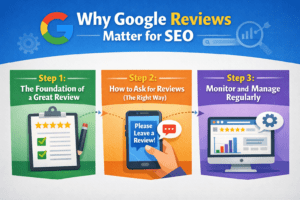
Step 1: The Foundation of a Great Review
You cannot shortcut a great customer experience. Often, we see contractors or local shops struggle with negative feedback because of simple mistakes like workers being late, job site messes, or poor communication. To get 5-star results, your team must show professionalism at every turn.
- Be Raving-Worth: Deliver service that makes people want to talk.
- Fix Issues Fast: If a mistake happens, fix it immediately without excuses.
- Use Your Network: If you are just starting, ask vendors, subcontractors, friends, and family to vouch for your work ethic. This builds an initial baseline of trust.
Step 2: How to Ask for Reviews (The Right Way)
Most satisfied customers are happy to leave a testimonial, but they need a reminder. The best time to ask is during the “golden window”-usually right after the final walkthrough or purchase when the project is fresh and excitement is high.
To make the process frictionless:
- Use Technology: Use your CRM to send automated follow-up emails.
- Make it Easy: Provide a direct Google review link or a QR code on invoices and job signs.
- Give a Script: Tell them it’s okay to mention specifics like the location, materials used, or the names of the crew members.
Pro Tip: Encourage customers to add photos. Reviews with images often stay at the top of the list, which helps reorder your reviews if a stray negative one appears.
Step 3: Monitor and Manage Regularly
Review management should be a weekly habit. You should aim for consistency rather than a huge burst of reviews followed by months of silence. Google favors businesses that get 2–3 regular reviews every month.
Use monitoring software like NiceJob, Podium, or GatherUp to get instant notifications. Most customers ignore feedback that is older than 90 days, so keeping your profile “fresh” is vital for maintaining your online reputation.
Step 4: Respond Like a Professional
Mastering the “art of the reply” is a critical ranking signal. You should respond to every single review, both good and bad.
- For Positive Reviews: Thank the person by name and mention a detail from the job (e.g., “We’re glad you love those quartz counters!”). This reinforces your brand values.
- For Negative Reviews: Stay calm. Acknowledge the problem and offer to fix it offline. This shows potential leads that you are the “real deal” and care about customer satisfaction.
- For Spam: If you get a bogus or inappropriate review, flag it for removal by the support team and post a professional reply stating that the record doesn’t match a genuine customer experience.
Step 5: Turn Feedback into Marketing Power
Your reviews are valuable marketing assets. Don’t let them just sit on Google. Use snippets of great reviews as “social proof” on your homepage and service pages. This builds immediate credibility for visitors.
You can even take your reviews and run them through a tool like ChatGPT to analyze the sentiment. This helps you understand the exact phrases your customers use so you can echo that language in your marketing copy. To stand out even more, ask your web developer to add Review Schema Markup. This allows star ratings to show up directly in Google search results, making your link much more attractive.
4 Key Benefits of Google Reviews
One of the biggest benefits of Google reviews is trust. People trust businesses that have real feedback from customers. Reviews act as social proof, showing that your business is legit. When you openly display both positive and negative reviews and respond to them, it shows transparency. This builds trust and creates a strong first impression.
Another benefit is backlinks and visibility. While most Google review links are “nofollow,” Google often pulls reviews from third-party sites like Yelp or G2. These platforms may include “dofollow” links, which can still support your SEO indirectly.
Reviews also drive direct targeted traffic. People reading your reviews are already interested in your service. They are past the awareness stage and closer to making a purchase decision. Good reviews push them further down the funnel.
Lastly, reviews act as a powerful online reputation management tool. They give you real insights into customer satisfaction. Even a bad review can be useful if you handle it correctly. When you respond publicly and fix the issue, it shows professionalism and builds credibility with new customers.
The Role of Local Directories and Link Building
While Google reviews are powerful, they work even better when combined with other SEO strategies. One important method is getting listed on local directories.
Google often pulls reviews from third-party sites, so having a presence on platforms beyond Google improves your credibility and reach.
This is where Resource Pages Link Building comes in. It involves getting your business listed on resource pages and directories that are relevant to your niche. These listings can drive traffic and improve your SEO performance.
How to Guarantee 5-Star Success
To turn reviews into actual revenue, you must see them as a primary ranking signal. Whether you are a landscaper, a builder, or a remodeler, digital trust signals are what help people find you. By creating a consistent process for asking, responding, and showcasing feedback, you strengthen your brand.
do google reviews help seo? Absolutely. They are the simplest and most cost-effective way to generate traffic and leads. When you combine great work with a solid review strategy and smart Resource Pages Link Building, you become unstoppable in local search.
Glossary of Key Terms
- Social Proof: The idea that people follow the actions of others. Positive reviews prove your quality.
- Local Pack: The top three business listings that appear on a map in Google search.
- NAP: Stands for Name, Address, and Phone number. Consistency here is key for SEO.
- Nofollow vs. Dofollow: Most GMB links are “nofollow” (they don’t pass direct ranking power), but third-party sites often provide “dofollow” links which are great for authority.
- Keyword Stuffing: Overusing words to trick Google. This is a bad practice and can lead to penalties.
To learn more about what Haxestech can do for you, get in touch with the team today.
FAQs
- Do Google reviews really help SEO?
Yes, Google reviews help SEO by improving local rankings, increasing trust, and sending strong signals to Google about your business quality. - How many Google reviews do I need for better rankings?
There is no fixed number, but consistent reviews (2–3 per month) are more effective than getting many at once. - Do keywords in reviews improve SEO?
Yes, reviews with keywords like services, location, and details can help Google understand your business and improve rankings. - Should I respond to all Google reviews?
Yes, responding to both positive and negative reviews builds trust and shows Google that your business is active. - Can negative reviews hurt SEO?
A few negative reviews won’t harm SEO if handled properly. Responding professionally can actually improve trust. - Are Google reviews more important than backlinks?
Both matter. Reviews help local SEO, while backlinks support overall SEO. A balanced strategy works best. - How do I get more Google reviews?
Ask customers politely, make the process easy with direct links, and follow up after a good experience. - Do reviews from other platforms help SEO?
Yes, reviews from sites like Yelp or directories can support SEO and improve your online reputation.