
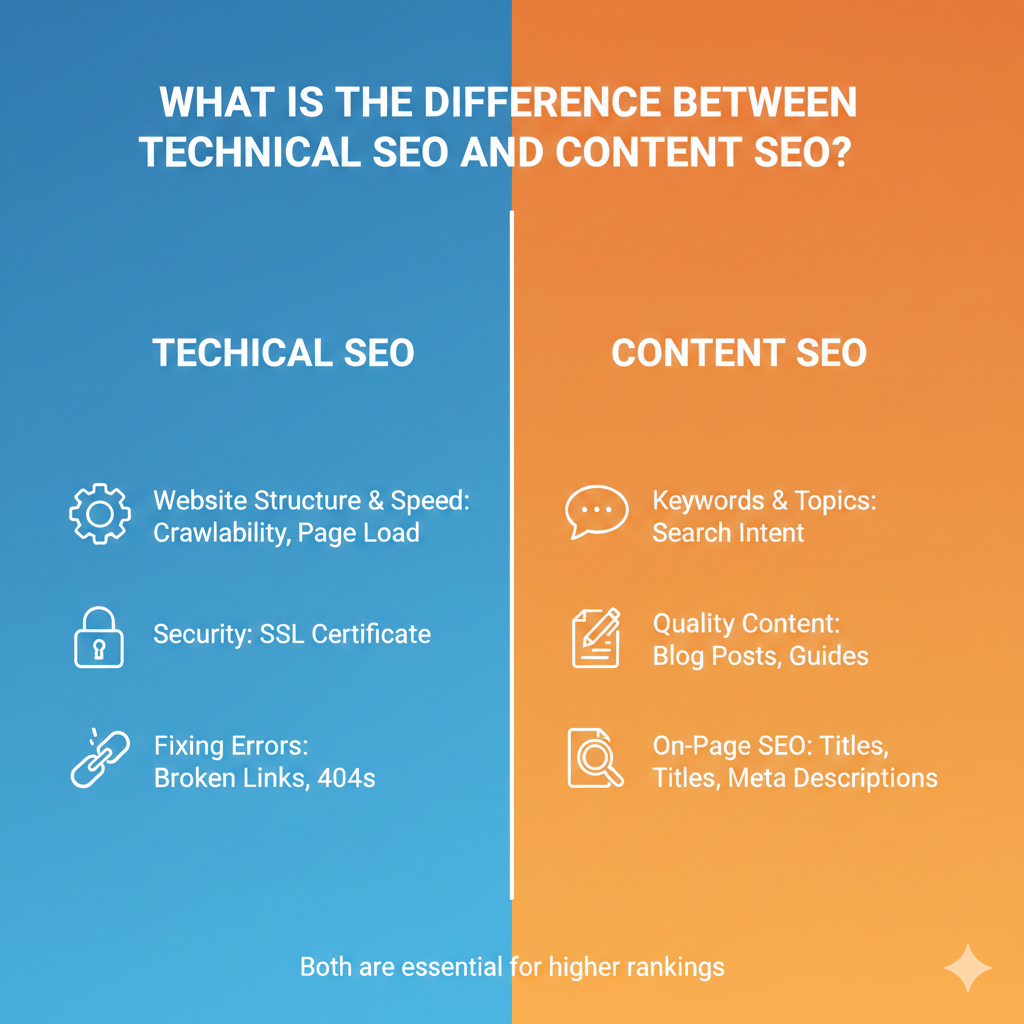
In digital marketing, there’s a common debate. It’s about the difference between technical SEO and content SEO. Think of your website like a house. Technical SEO is the foundation, plumbing, and wiring. Without them, the house isn’t livable. Content SEO is like the furniture, paint, and people in a house. It’s what turns a house into a home that people want to visit.
To achieve success on Google in 2026, you cannot choose one option. You need both working together in a symbiotic relationship. This guide will explain how these two pillars work, how they differ, and how to use them to rank higher.
Technical SEO: Building a Strong Foundation
Technical SEO is all about the “behind-the-scenes” work. It focuses on making your website easy for search engines like Google to read. If Google’s crawlers can’t access or understand your site, it doesn’t matter how great your writing is. You won’t appear in search results.
1. Website Speed and Performance
Think about the last time you clicked on a link and it took ten seconds to load. You probably left immediately. This What Is the Difference Between Technical SEO and Content SEO? is why page speed is a major ranking factor. Google uses Core Web Vitals to measure your site’s speed and smoothness. Key metrics include Largest Contentful Paint and First Input Delay. If your website speed is slow, Google will penalize you by moving you down the rankings.
2. Mobile-Friendliness
Most people today use their phones to browse the web. Because of this, Google uses mobile-first indexing. This means Google looks at the mobile version of your site first to decide where you should rank. A responsive design is a must for any successful website. It should look great on small screens.
3. Security and SSL
Site Security is a big deal. If your site lacks an SSL certificate, browsers may warn visitors with a “Not Secure” message. This kills your credibility. Using SSL encrypts data and makes your site a safe place, which Google rewards.
4. Structured Data and Schema
Schema Markup is a special code you add to your site to help Google understand your content better. It lets you use rich snippets. These are extra details like star ratings, prices, or FAQ answers that show up right in search results. This makes your link look more attractive and increases your click-through rates.
Content SEO: Winning the Hearts of Users
While the technical side handles the bots, Content SEO handles the humans. It’s about making content that targets specific keywords. This content answers what people are really searching for. This is often called matching search intent.
1. High-Quality Content Creation
The saying “Content is King” is still true. In 2026, the bulk of your SEO strategy should be about original content. You need to provide valuable and informative answers. When users find what they need, they stay longer. This lowers your bounce rates. It also shows Google that your site is helpful.
2. Keyword Research and Optimization
You need to speak the same language as your target audience. Keyword research shows you the exact words and phrases people use in Google searches. Put these keywords in your titles. Use them in your meta descriptions, headers, and alt tags too.
3. The Hub & Spoke Model
This is a smart content strategy. You create one main “Hub” page about a broad topic, like “SEO.” Then, you link it to smaller “Spoke” pages focused on specific sub-topics, such as “How to fix 404 errors.” This establishes your authority in a niche. It also helps turn potential customers into leads.

The Key Difference: How They Work Together
The main difference between technical SEO and content SEO is their focus. Technical SEO makes your site indexable and fast. Content SEO makes your site relevant and trustworthy.
Imagine you have a high-speed car (Technical SEO) but no fuel (Content SEO). You aren’t going anywhere. Or, imagine you have the best fuel in the world, but your car has no wheels. You’re still stuck. You need the synergy of both to move up the Google rankings.
Once you fix your broken images or links and have great content, you may need an extra boost. This is where Advanced Link Building Techniques come in. Getting other trusted websites to link to you shows Google that your site is a leader in its field.
How to Install a Winning SEO Campaign
To start your SEO campaign, you need a team with different skillsets. A Web Developer works on the technical backend. Meanwhile, a Writer and SEO Strategist focus on the creative frontend.
Step 1: Fix the Technical Issues
Your tech team should perform a regular audit to find and repair issues.
- Use XML sitemaps to show Google all your pages.
- Check for “noindex” tags that might block your best content.
- Fix 404 errors and broken links to keep the user experience smooth.
Step 2: Create a Content Plan
Your content should cover the entire buyer’s journey.
- Informational: Blog posts that answer “how-to” questions.
- Navigational: Pages that help people find a specific tool or brand.
- Transactional: Landing pages that encourage a buy or a newsletter sign-up.
Step 3: Keep it Fresh
SEO isn’t a “one-and-done” task. It requires Regular Content Updates and maintenance. Google loves sites that are up-to-date and fresh. Publish great content at least twice a week. Then, you could earn a “News Website Bonus” and rank higher.

Why the Fusion is Imperative
In the past, marketers could get away with doing one or the other. But today, the search engine algorithms are too sophisticated. They check everything: your site’s loading speed, content layout, and multimedia use. This includes videos and infographics to engage readers.
Mastering both technical SEO and content SEO future-proofs your website. Focus on the differences to enhance your skills. You’re not chasing the algorithm. You’re building a solid base for a smooth and enjoyable experience for every visitor.
Conclusion: Balancing the Two Pillars
To succeed in search, know this: technical SEO gets you in the door, but content SEO keeps people engaged. Combine Technical SEO (the backbone) with Content SEO (the meat). This mix builds a successful website that brings organic traffic and leads for years.
Always rank user experience. This applies when fixing your robots.txt or writing a new blog article. That is the real secret to ranking on Google.
Frequently Asked Questions (FAQs)
What is the difference between Technical SEO and Content SEO?
The difference between Technical SEO and Content SEO is that technical SEO improves website structure, speed, and crawlability, while content SEO focuses on creating relevant, valuable content for users and search intent.
Which is more important: Technical SEO or Content SEO?
Both are equally important. Technical SEO helps search engines access and index your site, while content SEO helps your pages rank and engage users.
Can content rank without Technical SEO?
High-quality content may rank temporarily, but without proper Technical SEO, indexing issues, slow speed, or poor mobile experience can limit long-term rankings.
Does Technical SEO affect user experience?
Yes, Technical SEO directly impacts user experience through page speed, mobile-friendliness, site security, and overall website performance.
How does Content SEO improve rankings?
Content SEO improves rankings by targeting keywords, matching search intent, improving readability, increasing engagement, and reducing bounce rates.
Is keyword research part of Technical SEO or Content SEO?
Keyword research is a core part of Content SEO, as it helps create content aligned with what users are searching for.