
Navigating the world of online growth is a big task. Every site owner wants to reach the top. But many people take bad shortcuts. These shortcuts lead to a high spam score. If you want to stay safe, you must learn how to reduce spam score the right way. A high score is like a dark shadow. It follows your site and tells search engines like Google that you are not honest. This can lead to banning or hiding your site. In this guide, we will look at how this metric works and how you can fix it.
What is Spam Score and Why Does It Matter?
Moz created the term “Spam Score.” It is a tool that looks at your site and gives it a score. This score shows the risk of your site getting a penalty. It is not a direct rule for Google, but it is a major warning sign. It looks for “red flags” like bad links, thin content, or risky code.
As Shahid Shahmiri once said, “Authority keeps you there longer.” If you want to keep your rank, you need to be a trusted source. If you have a high score, your organic traffic will drop. People will not trust your pages. They will leave quickly, and your bounce rate will go up. To keep your business safe, you must keep this number low.
Main Causes of a High Spam Score
Before you learn how to reduce spam score, you must know what causes the problem. Most issues come from trying to trick the system.
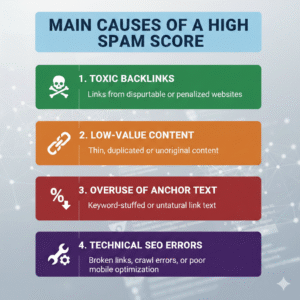
- Toxic Backlinks
Links are like votes for your site. But not all votes are good. If you have links from “link farms,” adult sites, or gambling sites, Google will see it as a trick. These are called toxic backlinks. They often come from PBNs (Private Blog Networks). If you have too many of these, they will devalue your site.
- Low-Value Content
Content is the most important part of your site. But many sites use AI to write thin content. This content has no real value. Google’s Helpful Content Update looks for this. If your site has duplicate pages or copied product descriptions, your rank will fall. You must provide unique insights to stay on top.
- Overuse of Anchor Text
Anchor text is the clickable word in a link. If every link to your site uses the exact same keyword, it looks fake. This is a sign of link manipulation. It can trigger the Penguin algorithm. A natural site uses a mix of brand names and simple words.
- Technical SEO Errors
The back end of your site must be clean. Crawling agents hate dead links (404 errors). People view things like hidden text or cloaking as black-hat tactics. Also, too many pop-ups or slow speed can ruin the user experience. Red flags show search engines that your site has poor management.
How to Reduce Spam Score in 5 Steps
Fixing your score takes time, but it is vital for your health. Here is the best way to do it.
Step 1: Clean Your Link Profile
You must find and remove bad links. Use tools like Ahrefs, Semrush, or Moz Pro to see your score. Look for links that seem suspicious. First, ask the owner of the other site to take the link down. If they do not help, use a disavow file. You can submit this to Google Search Console. It tells Google to ignore those bad links so they do not hurt you.
Step 2: Fix Your Content
Do not use AI to spam the web. You must refresh your old blog posts. Add new data and expert opinions. Use tools like Copyscape to check for duplicate content. If you find two pages that are the same, merge them. Make your text easy to read. Use short lines and clear words. This makes your site more accessible to everyone.
Step 3: Update Your Technical SEO
A secure site is a trusted site. Use HTTPS for your domain. Make sure your site works well on mobile phones. Use PageSpeed Insights to see how fast your site loads. If it is slow, compress your images and minify your code. A fast site has a better chance of ranking higher.
Step 4: Use Better Anchor Texts
Stop using the same keywords for every link. Use your brand name more often. This makes your link-building look natural. When your link profile has a variety of words, search engines see you as a real authority. This is a key part of how to reduce spam score effectively.
Step 5: Build High-Quality Backlinks
Once the bad links are gone, you need good ones. Focus on How to Create Quality Backlinks by writing great content. When you write something helpful, other sites will link to you for free. You can also do guest posts on trusted sites. Avoid buying links or using PBNs, as these will only raise your score again.
Monitoring Your Site for Success
Your work is always incomplete. You must check your site every month. Use Google Analytics to see where your traffic comes from. Set up Google Alerts for your brand name. This lets you see who is talking about you. If a spam site links to you, you can catch it early.
Check your Moz score often. A score of 1% to 30% is low risk. This is where you want to stay. If you hit 31% to 60%, it is a moderate risk. You must find the harmful signals and fix them right away. If your score is over 61%, it is a high risk. You need to work immediately to save your site from being blacklisted.
The Role of Professional Tools
While free tools are good, professional tools give more detail. Semrush and Ahrefs can show you “toxicity scores.” These scores tell you exactly which links are dangerous. Google Search Console is also a must-have. It shows you how Google sees your site. It will warn you about manual penalties or security issues like malware.

Final Thoughts on Site Health
In the end, keeping a low score is about being honest. Do not use tricks to get more clicks. Focus on the user. When you provide value, search engines will reward you. By following these steps on how to reduce spam score, you protect your business for the long term. You will earn more trust, more clicks, and more revenue.
Keep your content fresh, your links clean, and your tech sharp. This is the only way to build a digital asset that lasts. Don’t let a high spam score ruin your hard work. Take action today to clean your site and secure your future in the search results.
Frequently Asked Questions (FAQs)
Q1. What is spam score and why should I reduce it?
Spam score is a metric that shows how likely a website is to be penalized by search engines. Learning how to reduce spam score helps protect rankings and organic traffic.
Q2. What are the main reasons for a high spam score?
A high spam score usually comes from toxic backlinks, low-quality content, keyword stuffing, spammy outbound links, and technical SEO issues.
Q3. How to reduce spam score without harming rankings?
To reduce spam score safely, remove spammy backlinks, disavow toxic links, improve content quality, and follow ethical, user-focused SEO practices.
Q4. Which tools help check and reduce spam score?
Tools like Moz Spam Score, Google Search Console, Ahrefs, and Semrush help analyze backlinks and identify issues affecting spam score.
Q5. Does reducing spam score improve SEO performance?
Yes, understanding how to reduce spam score improves trust, strengthens site credibility, and supports long-term ranking stability.
Q6. How long does it take to reduce spam score?
Spam score improvement depends on the severity of issues, but consistent backlink cleanup and content optimization show results over time.