
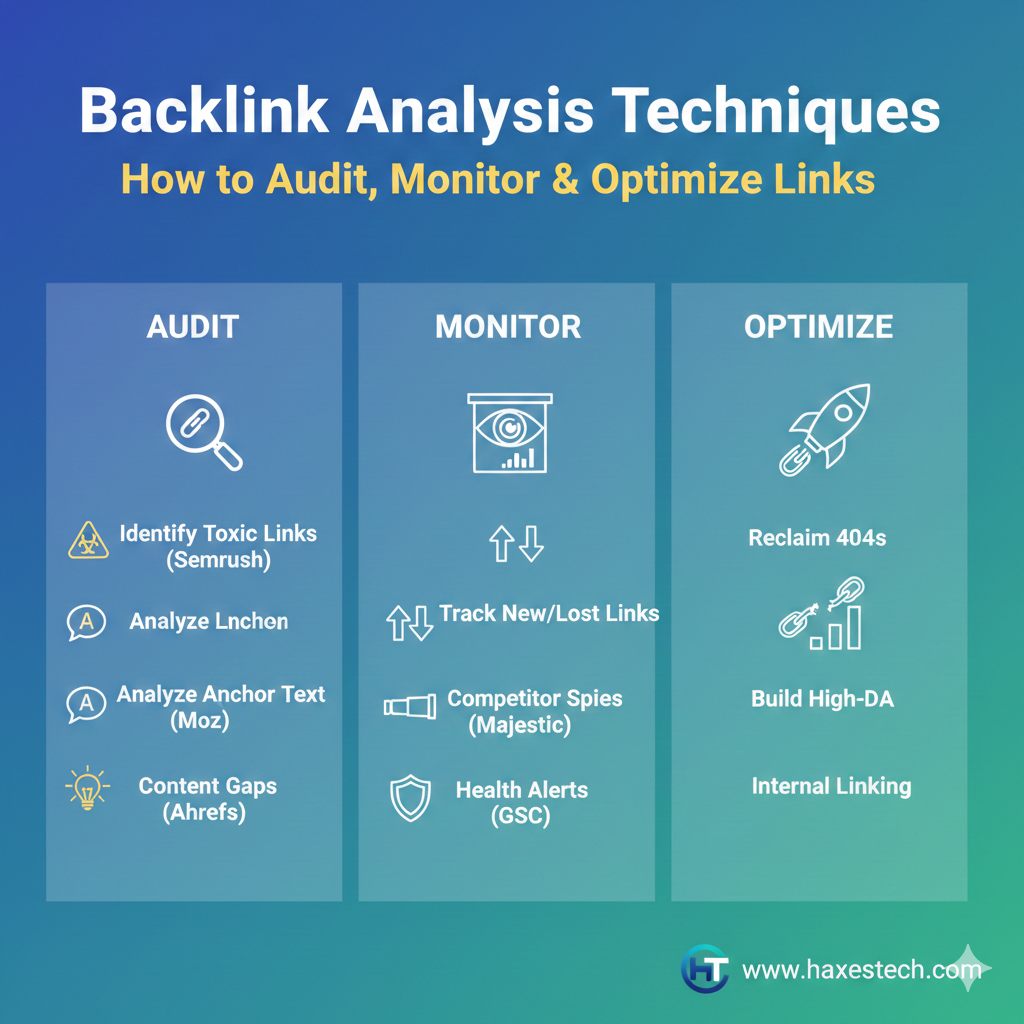
In digital marketing, it’s crucial to know how your website links to the internet. A comprehensive guide to backlink analysis techniques is your best asset. Backlinks are essentially “votes of confidence” that other websites cast. A link from a high-quality site boosts your credibility. It shows search engines that your content is trustworthy and authoritative.
But not all links are created equal. Some can propel you to the top of Google, while others can cause your rankings to disappear overnight. To win, you need a strategy that focuses on quality, relevance, and safety.
What is Backlink Analysis?
Success starts when you stop chasing “vanity metrics.” These are numbers that may look good but don’t benefit your business. Instead, focus on doing a diagnostic audit.
Backlink analysis means checking all the links to your site. You’ll look at four main factors:
- Relevance
- Authority
- Diversity
- Risk
By examining your external and internal links, you turn raw data into “link equity.” This means you understand the value each link passes to your pages. Know the difference between Search Console and Google Analytics. This will help you in the process. Google Analytics tracks what users do on your site. In contrast, Search Console shows how the internet views your site. It specifically lists the websites that link to you.
Why Should You Perform an Analysis?
If you want to protect your rankings, you must treat your links like a financial budget. Every analysis informs your future roadmap. A thorough audit helps
- Identify Authority Deficits: Check if your ranking problems affect the whole site. Or do they only impact certain pages?
- Spot Toxic Patterns: Find “spammy” or manipulative links that might trigger a penalty.
- Study Competitors: Find out where your rivals get their top links. Then, aim to copy their success.
- Measure Link Velocity: See how fast you gain or lose links. Compare this to your industry peers.
Phase 1: Identifying Your Targets
The first step in any backlink analysis is figuring out your competitors. You cannot rank effectively if you don’t know the “mountain” you have to climb.
- Identify Competitors: Don’t look at your direct business rivals. Look at the websites that currently hold the top three spots for your target keywords.
- Use Research Tools: Tools like SEMrush and Ahrefs let you enter a keyword. You can then see which sites are on top.
- Map the Gaps: Look for “RD Gaps” (Referring Domain Gaps). These are websites that link to all your competitors but not to you. These are your best opportunities for outreach.
Phase 2: Selecting the Best Tools
You could check links manually, but the internet moves too fast for that. You need a reliable toolset to manage the trillions of links existing online.
- Ahrefs: This is a favorite for many SEO experts. It offers a “Domain Rating” (DR) on a scale of 0 to 100. It is excellent for tracking “lost domains”—links that used to point to you but have been removed.
- SEMrush: Known for its massive database and “Toxicity Score.” It helps you spot “poisonous” links before Google does.
- Majestic SEO: This tool is unique because it focuses on “Trust Flow” (TF). It sorts links by topic. This way, you can check that your links come from relevant neighborhoods.
- Moz’s “Link Explorer” is well-known for its “Spam Score.” This score helps you spot if a linking domain seems like a link farm or a junk site.
- Google Search Console: This is your “source of truth.” It is a free tool from Google that shows exactly which links they have indexed for your site.
Phase 3: The Execution (Deep Dive)
Once you have your tools, it is time to perform the actual audit. This means gathering data from different indexes. This way, you avoid having “blind spots.””
Normalizing the Data
You should export your link data into a single sheet. You need to “dedupe” the list (remove duplicates) so you have a clear view of your unique referring domains. Focus on the “canonical” URLs to ensure your data is accurate.
Analyzing Anchor Text
Anchor text is the clickable word or phrase used in a link. In a healthy profile, most of your anchors should be your Brand Name or your URL. Google could see you as trying to game the system. This can happen if many links use “Exact Match” keywords. An example is “best cheap running shoes.””
- Safe Ratio: Aim for 50–70% Branded/URL anchors.
- Danger Zone: If “Exact Match” anchors go over 10–15%, it’s time to diversify.
Evaluating Link Attributes
Not all links pass power. You must check the “attributes” of your links:
- Dofollow: These links pass “SEO juice” and help your rankings.
- Nofollow: These links tell Google not to pass authority, but they still send traffic.
- UGC/Sponsored: These are labels for “User Generated Content” or “Paid” links. Using these correctly is vital for staying in Google’s good graces.
Phase 4: Cleaning Up the Profile
A huge part of a backlink analysis techniques comprehensive guide is risk management. If your metrics show you have picked up low-authority or “spams” links, you have a few choices.
- Reclaim and Fix: If a strong link is broken (showing a 404 page), contact the webmaster. Ask them to fix the URL. This is “link reclamation” and it is the easiest way to gain power.
- Request Removal: For bad links, you can ask the site owner to remove them or add a “no follow” tag.
- The Disavow Tool: If you can’t remove a bad link and fear a manual penalty, try Google’s Disavow tool. This tells Google to ignore those specific links. Warning: This should only be used as a last resort.
Phase 5: Turning Data into a 90-Day Roadmap
An audit is useless if you don’t act on it. Your backlink analysis techniques comprehensive guide should result in a “sprint-ready” task list.
- Days 1–30 (The Cleanup): Fix broken links, redirect old pages, and identify the most “toxic” links for removal.
- Days 31–60 (The Outreach): Build a “Prospect Universe.” These are sites that are relevant to your niche. Share high-quality content, case studies, or exclusive research with them. They will want to link to it.
- Days 61–90 (The Funnel): Use “Internal Linking.” Link your strongest pages to your “money pages.” These are the pages that drive your sales.
Why Quality Always Beats Quantity
In the early days of the internet, the person with the most links won. Today, Google is much smarter. One link from a trusted site, like a major news outlet, is very valuable. It’s worth more than 1,000 links from random sites that don’t relate.
To grow safely, follow “attribute guidance” and focus on “Editorial Links.” These are links added by a human editor within an article. This ensures that even when Google releases a new update, your site stays safe and continues to climb.

Conclusion
Mastering a backlink analysis techniques comprehensive guide is a continuous journey. You should perform a deep audit at least quarterly, or monthly if you are in a very competitive industry. Keeping your link profile clean, relevant, and trustworthy helps you build rankings. More than that, you’re creating a digital asset that adds value for years. Identify your competitors today. Use their strengths as a guide for your success.
Frequently Asked Questions (FAQs)
Q1: What is a backlink analysis techniques comprehensive guide?
A: It is a detailed resource that explains how to evaluate, monitor, and optimize backlinks to improve website authority, rankings, and traffic. It includes tools, strategies, audits, and actionable checklists.
Q2: Why is backlink analysis important for SEO?
A: Backlink analysis helps identify high-quality links, remove harmful links, and uncover opportunities for link-building, which directly affects search engine rankings and long-term site authority.
Q3: Which tools are used in backlink analysis?
A: Popular tools include Ahrefs, SEMrush, Moz, Majestic, Ubersuggest, and Google Search Console. Each tool helps assess link quality, anchor text, referring domains, and potential risks.
Q4: How often should I perform backlink analysis?
A: It’s recommended to perform backlink audits monthly or quarterly, especially after site migrations, redesigns, or noticing ranking drops, to maintain a healthy and authoritative link profile.
Q5: Can backlink analysis recover lost rankings?
A: Yes. By identifying lost or broken links, reclaiming link equity, cleaning toxic links, and strengthening internal links, backlink analysis helps restore rankings and improve overall SEO performance.
Q6: What is the difference between quality and quantity in backlinks?
A: Quality backlinks from relevant, authoritative sources matter more than sheer volume. Even a few strong, trusted links can outperform dozens of low-quality links in boosting SEO performance.
Q7: How does this guide help with link outreach strategies?
A: The guide explains how to segment links, identify high-value prospects, plan outreach campaigns, and prioritize editorial and topical links for maximum impact.