
Growing a business beyond borders is exciting, but it is also challenging. One big reason global websites fail isn’t design or products; it’s poor keyword choices. International SEO keyword research shows how people in other countries search online. It shows what words they really use. It is not about traffic numbers; it is about reaching the right people with the right words at the right time. When this research is done right, brands connect with real users. They avoid guessing and hoping for results.
In my experience, global websites save money. Brands that do keyword research help with this. Doing this early makes a big difference. Without it, even strong websites can’t rank well. They may attract the wrong visitors or waste money on content that doesn’t convert.
International SEO Keyword Research Is More Than Translation
Many businesses think global SEO starts and ends with translating their website. That idea causes most international SEO failures. Keyword translation and keyword research are not the same thing. A word that looks correct in another language may not be what people actually search for.
Spanish users in Spain search differently than those in Latin America. Both speak Spanish, but their word choices, tone, and intent vary. I once worked on a busy e-commerce project from another country, but sales were low. The issue was not the product or the price. The problem was that the keywords matched the language but not the local mindset. We adjusted the keywords for the region. The results then showed a big improvement.
International SEO keyword research studies search behavior. It doesn’t focus only on language. It looks at how people think, what words feel natural to them, and what problems they want to solve when they search.
Understanding Market Behavior Across Borders
International keyword research and domestic keyword research serve different purposes. Domestic SEO usually deals with small changes between regions. International SEO deals with completely different cultures, habits, and expectations.
Each market has its own pop culture, slang, values, and buying behavior. Even countries that share a language may use different words for the same thing. A simple example is how people search for computers. Some Spanish speakers search for “ordenador,” while others use “computadora.” Choosing the wrong word can attract visitors who are not ready to buy or who leave in a hurry.
This difference becomes even clearer in e-commerce. I’ve noticed some websites get a lot of visitors from other countries, but they hardly make any sales. The keywords attracted users, but the intent did not match. After we did keyword research for each target market, traffic quality improved.
Search Engines and Global Competition
Google is the most popular search engine in many countries, but it is not the only one that matters. In China, Baidu is dominant and In South Korea, users prefer Naver and In Russia, Yandex has a broad user base. Each platform works differently and ranks content in its own way.
Relying only on English keywords can also limit growth. English keywords usually get a lot of searches. But they can be quite competitive and costly. Non-English keywords usually have lower competition and lower cost-per-click. This makes them valuable opportunities for businesses that want faster results.
For global brands, the goal is not high traffic. The goal is useful traffic that matches intent. This shift changes how we plan content strategy and how we choose keywords.

Why Native Insight Matters So Much
One of the biggest mistakes in international SEO is skipping native expertise. Native speakers understand natural phrases, tone, slang, and cultural meaning.
I’ve avoided keyword projects in languages I don’t fully grasp. Even if tools show data, without native knowledge it is easy to misunderstand intent. A keyword may look correct but feel strange to real users.
Working with native linguists, translators, or international SEO experts helps avoid this issue. They help build keyword lists that sound natural. These lists match the actual ways people search online. This approach leads to stronger rankings and better engagement.
Tools That Support International Keyword Research
While human insight is critical, tools make international keyword research practical at scale. Several tools are widely used by SEO professionals.
Semrush is popular. It has big keyword databases, location targeting, and language options and It helps identify related keywords, common questions, and competitor data. It also supports tracking rankings across different countries.
Ahrefs Keyword Explorer is great for checking keyword difficulty. It also looks at backlinks and popularity in various regions. It shows how keywords do in various countries and languages. This helps compare different markets.
Moz supports keyword research along with site audits, link analysis, and competitor insights. It works well for broader SEO planning.
Google Keyword Planner helps you see search volume and trends straight from Google. While it has limits, it works well alongside paid tools.
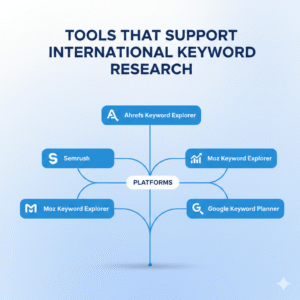
Using many tools together gives a clearer picture and helps reduce errors.
Executing Keyword Research With Relevance and Intent
Good keyword research always starts with relevance. Search engines rank content based on how well it matches what users are searching for. Recent algorithm updates emphasize helpful, original content. They push low-quality pages down in search results.
Understanding your audience is key. You must consider the country, industry, language style, and user intent. For example, users searching for information behave differently than users searching to buy.
I often check customer emails, support questions, and sales chats. These sources reveal real search intent that keyword tools may not show. Some keywords may show low volume but bring highly qualified traffic.
Competitor research also plays an important role. Keyword gap analysis helps identify missing opportunities. Reviewing top-ranking pages shows how competitors structure content and localize their messaging.
This stage is when many businesses wonder what to do after keyword research. The answer is simple: use the data with purpose, not randomly.
Localizing Keywords the Right Way
Once you select keywords, you must localize them, not translate them. Localization means adapting keywords to fit cultural context, behavior, and meaning.
For example, in the U.S., people often search for “laptops.” In some European countries, they prefer “notebooks.” Using the wrong term can attract visitors, but it won’t bring the right users.
Localization ensures that content feels natural and trustworthy. It improves click-through rates, engagement, and rankings in international search engine results pages.
This process requires careful attention to syntax, tone, and common phrases. Small changes can lead to large performance differences.
Testing Keywords and Measuring Results
After the team implements keywords, testing becomes critical. Not all keywords perform as expected. Some high-volume keywords are too competitive, while lower-volume keywords may drive better results.
SEO tools help measure search volume, competition, keyword difficulty, and ranking changes. Monitoring performance allows teams to adjust strategy based on real data.
Balancing high-competition and low-difficulty keywords helps build steady growth. Over time, rankings improve as authority increases.
International markets are always changing. Search trends shift, user behavior evolves, and algorithms update. Regular reviews ensure that content stays relevant and visible.
Supporting SEO With Structure and Performance
Keyword research alone is not enough. Technical structure supports international SEO success.
Clean URLs help search engines. Language indicators, country paths, and hreflang tags show the right content. Without proper structure, even good content may struggle to rank.
Website speed also matters. Slow websites increase bounce rates and reduce engagement.
Improving performance boosts user experience and global rankings. You can do this by:
- Using image compression
- Implementing caching
- Designing for mobile
- Utilizing content delivery networks

Achieving success in scaling international SEO.
International SEO has more moving parts than domestic SEO. Language, culture, search engines, tools, and technical setup all work together. This complexity creates room for error, but also opportunity.
Many businesses opt for professional international SEO services to handle this task. Expert support helps ensure accuracy, efficiency, and long-term growth.
When done correctly, international SEO keyword research becomes a powerful growth engine. It helps brands enter new markets confidently. They can connect with real users and build global visibility. This way, they save time and resources.
Frequently Asked Questions (FAQs)
What is international SEO keyword research?
International SEO keyword research is the process of finding the right keywords people use in different countries and languages when searching online. It helps businesses attract the right global audience.
Why is international SEO keyword research important?
It is important because users in different regions search in different ways. Without proper research, websites may get traffic that does not convert or rank for the wrong keywords.
How is international keyword research different from local SEO?
Local SEO focuses on one country or language, while international keyword research covers multiple countries, languages, dialects, and search behaviors.
Can I just translate my keywords for international SEO?
No. Translation alone is not enough. Keywords must be localized to match how people think, speak, and search in each region.
Which tools are best for international SEO keyword research?
Popular tools include Semrush, Ahrefs, Moz, and Google Keyword Planner. Using more than one tool gives better accuracy.
Do I need native speakers for international keyword research?
Yes. Native speakers understand real search intent, cultural meaning, and natural phrases better than tools alone.
How often should international keywords be reviewed?
Keywords should be reviewed regularly because search trends, competition, and user behavior change over time.
Does international SEO keyword research help rankings?
Yes. When done correctly, it improves rankings, traffic quality, and visibility in international search engine results.