
If you’ve ever invested in link building, you’ve asked yourself: how long do backlinks take to work? In my 10 years of running campaigns and ranking over 150 websites, the honest answer is: it depends. Still, there are clear patterns. To understand how long backlinks take to work, you need to know what happens behind the scenes. Consider the factors that affect speed and the strength of your foundation. Remember this before we dive in: backlinks are key to search visibility. This ties into a bigger topic often asked by beginners-What is SEO? But we’ll focus on backlink timing and performance today.
From Publication to Ranking Adjustments
When another site publishes a backlink, it takes time for rankings to improve. Google must first find, crawl, and index the linking page. It first checks the link’s context, relevance, and trustworthiness. Then, it influences page authority and search performance.
This process has several stages:
- Crawling: Googlebot finds the page with your backlink.
- Indexing: The page and link get added to Google’s index.
- Link Graph Updates: The system recalculates your site’s authority.
- Ranking Adjustments: Rankings change if the link is influential.
Depending on many factors, this can take a few days, 2 weeks, or even several months. A high-quality backlink can lead to quick results. But there’s no guarantee of instant success.
The 7 Days to 2 Months Reality
When clients ask how long links take to work, I provide a realistic range. This range is 7 days to 2 months. That range comes from real data across industries.
A new website lacks domain authority, search traffic history, and an SEO base. This is the worst scenario. I’ve seen brand new websites with 10 pages add 100 links a week and still see no traffic for months. The same applies to a new blog post on a site that is still emerging. Even if it receives many links, you may wait a long time before results appear.
A website with strong domain authority and some traffic can change rankings. This is especially true if it’s 12 to 24 months old. Changes can happen in 4 to 6 weeks. This is true for less competitive keywords. And for large websites with strong authority, new links can work in 2–3 days.
I once got a link from Hubspot.com to haxestech.com. This site has been online since 2007. It has an authority score of 47 out of 100, over 2,500 linking domains, and 100,000 visits each month. After adding the link “What is SEO” on the home page, the keyword rose 24 spots on Google. The keyword had 22,000 searches each month, based on Semrush data. It was also very competitive. That experience showed me something important. A strong foundation can turn one good backlink into quick momentum.

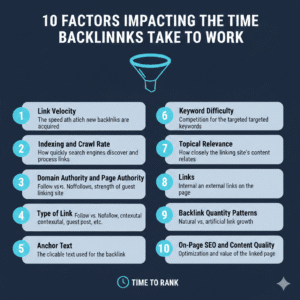
10 Factors Impacting the Time Backlinks Take to Work
The timing of backlink impact isn’t random. It’s influenced by several core elements:
- Link Velocity.
There is no exact number of links before Google penalizes you. I once launched a Digital PR campaign that earned 120 backlinks to a single blog post in one month. That page has ranked #1 on Google for a competitive guest posting ROI keyword since 2019. High-speed link building does not harm SEO when it occurs in a natural manner.
- Indexing and Crawl Rate.
If a website blocks pages or makes them inaccessible, search engines won’t crawl or index them. Crawl rate depends on server bandwidth and URL popularity. Crawlers access popular pages faster; they can slow things down for new ones.
- Domain Authority and Page Authority.
Domain Authority (Moz), Authority Score (SEMRush), Domain Rating (Ahrefs), and Domain Trust (SERanking) all measure link strength. They show how strong your links are. They measure the power of your link profile. Each metric measures link strength.
They use a 1–100 scale.
Since Google ranks pages, not websites, Page Authority can make backlink efforts faster.
- Type of Link.
Dofollow links pass link juice and influence rankings. Nofollow backlinks might not improve rankings in a direct manner. But they help create a natural link profile. Dmytro Sokhach is the CEO of Editorial.Link. He thinks it’s good to work with trusted link-building companies. They can make a big difference. They give you an edge. And they also help keep your profile trustworthy.
- Anchor Text.
Anchor text describes the topic clearly and helps links work faster.
- Keyword Difficulty.
Easy keywords may rank in 5–10 days. Medium or high difficulty keywords may take 30 to 40 days or longer. This is especially true in competitive industries.
- Topical Relevance.
A real estate website that links to an agency with clear anchor text makes sense. Search engines understand meaning best when links come from sites in the same niche. Relevant links matter.
- Links.
Links in the main content area are more valuable, as John Mueller noted in a Google Hangout. Links hidden in the footer or sidebar don’t hold as much weight. Link position directly influences speed.
- Backlink Quantity Patterns.
A steady link profile is stronger. Sudden spikes from manipulation are not good. But natural spikes from viral digital PR campaigns are acceptable.
- On-Page SEO and Content Quality.
Backlinks won’t help if your content doesn’t match search intent. Also, it needs to follow best practices. Use optimized titles, H1s, and internal links. A backlink shows confidence. Your content needs to earn its rank.
Ranking Movements and Competitive Pressure
Once Google indexes a strong backlink, ranking changes can appear within 2–4 weeks. In competitive industries, sites with more backlinks can slow down progress. It may take up to 3 months to see real improvements.
Early in a campaign, you might jump 5–10 positions. As you near the top results, gains shrink to 1–2 positions at a time. This happens because higher-ranking sites have stronger authority.
This is why link building is an ongoing process. You might see ranking changes before things settle down. This is common with new links or fresh pages. That’s normal.
Accelerating Backlink Impact the Smart Way
Although you can’t force Google to reward links immediately, you can hurry the process. Increasing outreach investment helps you earn more backlinks faster. Aim for high-authority and relevant websites. They might cost more, but they can significantly enhance your rankings.
Another approach is building content that attracts backlinks. When journalists and bloggers discover strong pages naturally, those links compound over time. Linking from those pages to money pages helps boost performance. Money pages include landing pages, eCommerce collections, and sales blog posts.
It’s important to avoid common misconceptions. Not all backlinks work the same. A relevant dofollow link from a good site is much stronger than a low-quality comment link. Paid backlinks from known sellers may not contribute to rankings. And although improvements can appear quickly, earning meaningful results takes time.
If you’ve waited more than 2 months with no movement, troubleshoot. Check for crawl blocks, noindex tags, and spam content. Also, see if you’re targeting a competitive keyword without enough support.
So, How Long Do Backlinks Take to Work in Practice?
You can expect early ranking signals in 2–4 weeks based on years of testing and client data. Many see measurable progress in 3–5 months. As outreach and authority grow, results will compound and strengthen.
Backlinks take time to work.
The real answer depends on a few factors:
- Authority
- Relevance
- Indexing speed
- Competition
- Execution quality
Backlinks can improve rankings. This works best with strong technical SEO, a good user experience, and quality content. But the outreach effort needed takes time.
Knowing these layers helps you see how long backlinks take to work. This way, you can predict results accurately instead of hoping for quick wins.
Frequently Asked Questions (FAQs)
- How long do backlinks take to work for a new website?
For a new website, backlinks can take 1–3 months to show clear ranking improvements because the domain has low authority and limited trust. - Can backlinks work in a few days?
Yes, but usually only for strong, aged websites with high authority. In most cases, it takes at least a few weeks to see movement. - Do all backlinks work at the same speed?
No. High-quality, relevant, dofollow backlinks from trusted websites work faster than low-quality or unrelated links. - Does keyword competition affect how long backlinks take to work?
Yes. Low-competition keywords may improve in weeks, while competitive keywords can take months even with strong backlinks. - Do nofollow backlinks help rankings?
Nofollow links do not directly pass link juice, but they help create a natural backlink profile and can support overall SEO growth.