

In today’s competitive digital landscape, seo for architects is no longer optional-it’s a growth engine. I’ve seen incredibly talented firms with stunning portfolios struggle simply because they weren’t visible on Google. Even the most innovative designs won’t matter if your ideal client can’t find you in search results. Done right, seo for architects positions your firm in front of decision-makers at the exact moment they’re searching for residential, commercial, or specialized architectural services. Whether your firm specializes in residential homes, commercial spaces, public infrastructure, or sustainable design, a data-driven strategy turns your website into a lead-generating machine.
Before You Start: Know Your Customer, Your Services, and Your Goals
Success in the digital age begins by defining who you are trying to reach. Before overhauling your architecture website, your firm must identify its ideal clients and the specific offerings that drive the business. Whether you operate in the Urban, Environmental, Healthcare, Educational, or Retail sectors, your marketing must align with your customer’s journey.
Establish a baseline of current leads, emails, and phone calls to measure future growth. Set clear goals for how you want to rank for design specialties, such as “ranch-style homes” or “modern cottages.” By understanding the geography of your services and the informational needs of a client-such as design examples and pricing information-your SEO efforts will effectively convert interest into client acquisition.
What Does SEO for Architects Even Mean?
In the realm of architecture, search engine optimization is more than just a technical task; it is the art of aligning user intent with the vision of an architect. Keyword research tools like Ahrefs reveal a massive universe of over 128,000 keywords related to the term “architect.” However, a savvy business owner knows that quality beats quantity. While thousands might search for “how to become an architect,” your goal is to optimize for the high-value client looking to build. The objective is a high ranking that connects your unique style to the specific people searching for it.

1. Local SEO for Architects: The Digital Front Door
For firms operating in a specific city or region, local SEO is the cornerstone of location-based architecture projects. Your Google Business Profile (formerly Google My Business) is your digital storefront. To dominate the local map listings, you must:
-
Maintain an Accurate NAP: Ensure your Name, Address, and Phone number are consistent across the web.
-
Optimize Your Profile: Add high-quality project images, accurate office hours, and compelling service descriptions.
-
Target Local Keywords: Use phrases like “Architect in [City]” or “Custom home architect [Neighborhood]” in your headers and title tags.
-
Build Local Landing Pages: If you serve multiple regions, create unique pages filled with localized testimonials and relevant regional projects.
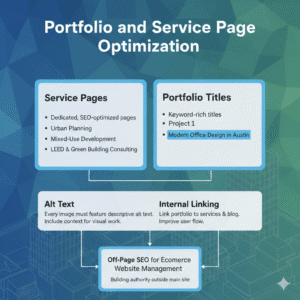
2. Portfolio and Service Page Optimization
Traditional architecture websites often over-rely on imagery without providing context for search engines. Search engines cannot “see” a photograph; they need text to understand it.
-
Service Pages: Create a dedicated, SEO-optimized page for every offering, such as Urban Planning, Mixed-Use Development, or LEED & Green Building Consulting.
-
Portfolio Titles: Use keyword-rich titles like “Modern Office Design in Austin” instead of generic labels like “Project 1.”
-
Alt Text: Every image must feature descriptive alt text. This is a great place to include context for your visual work.
-
Internal Linking: Link your portfolio pieces to related services and blog content to improve user flow. Interestingly, while architects focus on local building, a similar internal logic applies to Off Page SEO for Ecommerce Website management, where building authority outside the main site is key to ranking.
3. Content Marketing: Establishing Topical Authority
Content is the engine that drives rankings and earns backlinks. By answering client questions through long-tail keywords, your site stays fresh and relevant. Consider blog topics such as “The Permit Process for Commercial Projects” or “2026 Design Trends in Urban Multifamily Developments.”
Informative pieces on budgeting, sustainable design, and energy efficiency build deep trust. Each post should target a specific keyword and include internal links to your service pages. Aim for a consistent content frequency-posting 2–4 times a month is a winning marathon pace for seo for architects.
4. Technical SEO and User Experience (UX)
The code beneath your website must allow search engines to crawl and index your work effortlessly.
-
Mobile Optimization: Over 60% of searches happen on mobile devices; your site must be responsive.
-
Site Speed: Reduce loading times for heavy portfolios by optimizing code and using browser caching.
-
Security: Always use an SSL Certificate (HTTPS) to build trust with both Google and your clients.
-
Schema Markup: Implement “LocalBusiness” and “Organization” structured data to help search engines understand your firm’s details, appearing in rich results with star ratings and office hours.
5. Link Building and Authority Growth
To rank highly, your firm needs authority built through backlinks from reputable websites. You can build this by:
-
Submitting to Design Directories: Sites like Architizer, Houzz, AIA.org, and Clutch are essential.
-
Guest Blogging: Contribute expert articles to architecture magazines, real estate blogs, or local news outlets.
-
Collaborating with Partners: Ask general contractors, developers, and interior designers to link to shared project pages.
SEO Results: What to Expect
SEO is a marathon, not a sprint. During Months 1–2, the focus is on technical fixes and keyword research. By Months 3–4, you begin publishing new content and building local listings. Between Months 5–12, you will likely see the first signs of organic lead generation, resulting in dominant positioning and a consistent flow of leads from organic search.
Case Study: A 340% Increase in Organic Leads
A boutique residential firm in Northern California partnered with an SEO agency to revamp its strategy. By creating location-optimized service pages and adding keyword-rich copy to every portfolio project, they achieved a 340% increase in organic traffic within 12 months. This led to 24 new consultation requests and a $1.2 million project pipeline, proving that a professional approach to seo for architects is an investment that pays for itself many times over.
FAQs
1. What is SEO for architects?
SEO for architects is the process of optimizing an architecture firm’s website to rank higher on search engines like Google. It involves keyword research, local SEO, content creation, technical optimization, and link building to attract potential clients searching for architectural services.
2. Why is local SEO important for architecture firms?
Most architecture projects are location-based. Local SEO helps your firm appear in map results and local searches such as “architect in [city].” Optimizing your Google Business Profile and maintaining consistent NAP (Name, Address, Phone number) improves visibility in your service area.
3. How long does it take to see results from SEO for architects?
SEO is a long-term strategy. Typically, technical improvements and keyword research happen in the first 1–2 months. By months 3–6, content and local optimization begin showing traction. Significant organic lead growth often appears between 6–12 months.
4. What kind of content should architects publish?
Architects should create blog posts and service pages that answer client questions. Topics can include design trends, budgeting tips, permit processes, sustainable architecture, and case studies. Consistent, keyword-focused content strengthens authority and improves rankings.
5. Do portfolio images help with SEO?
Yes, but only when optimized properly. Since search engines cannot “see” images, you must add descriptive alt text, keyword-rich project titles, and supporting content. This helps search engines understand your work and rank it appropriately.
6. Is link building necessary for architects?
Absolutely. Backlinks from reputable platforms such as Architizer, Houzz, AIA, and Clutch increase your website’s authority and improve search engine rankings.
7. Can SEO really generate architecture leads?
Yes. When implemented correctly, seo for architects attracts high-intent clients actively searching for design services. Over time, this results in increased organic traffic, consultation requests, and a predictable pipeline of qualified projects.