
Building effective Internal Linking Strategies for SEO Success is one of the most impactful ways to improve website performance, boost search engines ranking, and guide users through a seamless journey. From my experience, when every website page is thoughtfully connected, visitors naturally explore content from a blog post to a pricing page, product page, or a related item. This keeps engaged users, helps guide them toward high value pages, and supports the customer journey. At the same time, Google crawler follows links across the site structure, helping discover pages, reducing orphaned pages, and ensuring more indexed pages for better visibility.
What is Internal Linking and Why Does it Matter?
Think of internal links as the circulatory system of your website. They allow “link equity” or ranking power to flow throughout your site. When search engine crawlers, like Google’s bot, land on your domain, they follow these branching paths to discover and index your pages. A well-mapped site improves “crawlability,” ensuring that search engines don’t just find your front door, but see every single room inside. From a user’s perspective, these links provide relevant information, keeping them engaged and moving them closer to a conversion.
Internal Links vs. External Links and Link Building
It is easy to get confused between different types of links. While external links point to third-party sources to build credibility, internal links are about your own ecosystem where you have total control. Similarly, don’t confuse this with “Link Building.” Link building involves networking with other site owners to get inbound links from their platforms. While that is important, Internal Linking Strategies for SEO Success are an intentional network that you build yourself to meet your specific business goals.
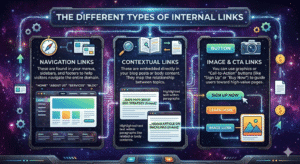
The Different Types of Internal Links
To have a sophisticated strategy, you should use different sections of your website layout:
- Navigation Links: These are found in your menus, sidebars, and footers to help visitors navigate the entire domain.
- Contextual Links: These are embedded directly in your blog posts or body content. They map the relationship between topics.
- Image & CTA Links: You can use graphics or “Call-to-Action” buttons (like “Sign Up” or “Buy Now”) to guide users toward high-value pages.
Crafting a Strategic Internal Linking Roadmap
Achieving top rankings is about credibility. Your strategy should start with meticulous keyword research. By identifying terms tailored to your niche and audience, you can create “anchors”-the clickable text of a link-that signal value to search engines.
I always recommend using “Topic Clusters.” This involves a main “Pillar Page” (like a broad guide on Marketing) supported by smaller articles (like “Social Media Tips” or “Email Tactics”). Linking these together shows Google that your main page is an authoritative resource. This is also one of the best ways to avoid Common SEO Mistakes and How to Fix Them, such as having “orphaned pages” that no one can find.
The Power of Descriptive Anchor Text
The words you choose for your links matter. Instead of using generic phrases like “click here,” use descriptive anchor texts. For example, “How to improve Google Local ranking” tells both the reader and the search engine exactly what is on the next page. This captures the reader’s attention and reduces the chance of them “bouncing” or leaving your site quickly.
Advanced Maintenance and Technical Cleanup
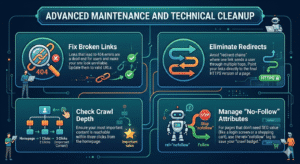
A successful Internal Linking Strategies for SEO Success is never a “set and forget” task. It requires regular maintenance. I suggest performing an internal link audit every few months.
- Fix Broken Links: Links that lead to 404 errors are a dead end for users and make your site look unreliable. Update them to valid URLs.
- Eliminate Redirects: Avoid “redirect chains” where one link sends a user through multiple hops. Point your links directly to the final HTTPS version of a page.
- Check Crawl Depth: Ensure your most important content is reachable within three clicks from the homepage.
- Manage “No-Follow” Attributes: For pages that don’t need SEO value (like a login screen or a shopping cart), use the rel=”nofollow” tag to save your “crawl budget.”
Using Tools for Better Performance
You don’t have to do this alone. Tools like Google Search Console provide an “Internal Links” report that shows which of your pages have the most incoming links. You can also use automation tools like Siteimprove to map your structures and find hidden issues. By performing regular quality assurance on your links, you improve your site’s ROI and ensure that your Internal Linking Strategies for SEO Success keep your content visible and competitive for years to come.
Building and Maintaining a Practical Internal Linking Strategy
A practical internal linking strategy integrates into the SEO workflow and content creation. Start with site structure planning for top level pages and hierarchy structure, then expand into topic clusters, pillar pages, and supporting articles. Use cluster linking, contextual links, navigational links, and thoughtful links placement to strengthen authority signals. Optimize anchor text with descriptive anchors, varied anchors, and keyword aligned anchors. Conduct internal link audits regularly to fix broken internal links, remove unnecessary links, and address pages no longer exist, 404 errors, or server errors using Google Search Console. Remove redundant links, off-topic content, generic text, or vague text to avoid cluttered user experience and ensure effective internal linking strategy with professional support like Sure Oak.
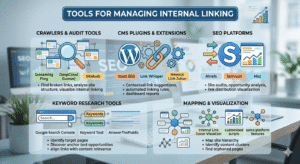
Tools for Managing Internal Linking
Specialized internal linking tools support marketing optimization and automation tools. Platforms like Siteimprove and Google Search Console provide internal links report, showing incoming links and insights from a full site crawl. Siteimprove SEO Intelligence highlights broken links detection, orphaned pages detection, and weak link structures. Teams can monitor Content Behavior Analytics, prioritize pillar pages, and track traffic metrics alongside engagement metrics. Advanced tools assist with anchor text validation, semantic linking, technical SEO, Quality Assurance, redirect chains detection, HTTP links detection, crawlability issues, and performance measurement, enabling long-term internal linking strategy management.
Content Clusters and Authority Flow
A strong site architecture relies on a logical structure revealing topic relationship between central pages and supporting content. For example, a marketing agency blog might create a pillar page for Content Marketing Strategy, supported by supporting articles like Content Calendar, Content Distribution Tactics, and Repurposing Blog Posts. Together, these form a content cluster anchored by an authoritative resource. External backlinks pass link equity and PageRank from high authority page to lower authority page, improving search results visibility.
Engagement and Performance Signals
Effective linking generates measurable traffic growth. Strong internal link signals revive underperforming pages, while search engines discover more crawled pages, index pages, and display ranked pages more prominently. Good structure improves crawl efficiency, preserves crawl resources, manages the crawl budget, and keeps key pages accessible even in large websites with high URLs volume. For readers, this improves user experience, engagement signals, bounce rate, session duration, and alignment with search intent, supporting long-term SEO performance.
FAQs:
Q1: What are internal linking strategies for SEO success?
A1: They are techniques to connect pages within your website, helping users navigate and search engines understand your content structure.
Q2: Why is internal linking important for SEO?
A2: Internal linking improves site structure, distributes authority, boosts page rankings, enhances user experience, and helps Google index pages.
Q3: How do I create a strong internal linking strategy?
A3: Plan site hierarchy, build topic clusters with pillar pages, use contextual and navigational links, and optimize anchor texts.
Q4: Can internal linking fix underperforming pages?
A4: Yes, linking strong pages to weaker ones increases visibility, engagement, and indexing for pages that aren’t ranking well.
Q5: What tools can help manage internal links?
A5: Tools like Siteimprove and Google Search Console track links, detect broken links, optimize anchor texts, and improve link coverage.