
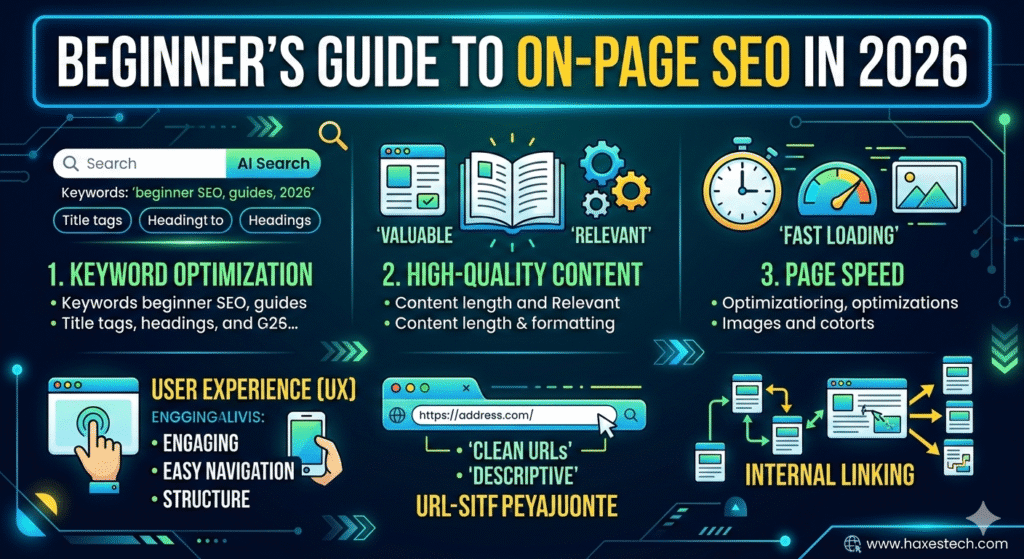
The world of search marketing is undergoing a massive transformation, but the core of organic success remains rooted in how you optimize your individual pages. This Beginner’s Guide to On-Page SEO in 2026 is designed to help you navigate a landscape where AI, Large Language Models (LLMs), and human intent converge. Gone are the days of mere keyword placement; today, on-page SEO is a holistic set of improvements made directly within your page and its HTML to ensure search engines can crawl efficiently and users can find exactly what they need.
What is On-Page SEO? (And Why It Matters)
On-page SEO is the process of optimizing “on-site” elements-including content, headings, internal links, metadata, images, and structured data-to signal quality to both Google and AI tools. It is distinct from Technical SEO (which handles sitemaps and server issues) and Off-page SEO (which focuses on external signals like backlinks).
While off-page factors are important, on-page work is your starting point. It offers immediate, tangible results because you have total control over the environment. Understanding these factors is the ultimate recipe for organic success, ensuring your pages meet the high expectations of the modern user experience.
The 3-Part Mental Framework
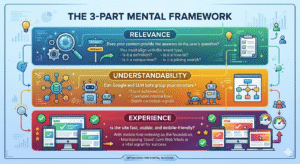
To optimize any page effectively in 2026, focus on this trio of objectives:
-
Relevance: Does your content provide the answers to the user’s question? You must align with the intent type, whether it is a definition, comparison, how-to, or pricing search.
-
Understandability: Can Google and LLM bots grasp your structure? This is achieved via crawlable internal links and stable canonical signals.
-
Experience: Is the site fast, usable, and mobile-friendly? With mobile-first indexing as the foundation, maintaining “Good” Core Web Vitals is a vital signal for success.
Helpful Content: The Golden Rule
Since the landmark updates of previous years, Google has made one thing clear: Helpful Content is King. To satisfy a modern reader, your research must show depth and originality. Avoid clickbait headlines and automated errors; instead, focus on factual accuracy and trust.
Expertise is now measured through E-E-A-T (Experience, Expertise, Authoritativeness, and Trustworthiness). Demonstrate your knowledge with certifications, reviews, and media proof. When your content is people-first and authoritative, you’re not just chasing rankings-you’re building a resource that users will want to bookmark, share, and recommend.
The 60-Minute On-Page SEO Sprint
A practical workflow keeps optimization focused and repeatable. Start by checking indexability-ensure noindex isn’t blocking visibility. Review duplicates and confirm canonical consistency. Then refine the title tag so it matches the visible heading and improves click-through rates. A compelling meta description should summarize the page clearly and encourage clicks, without relying on outdated meta keywords.
Next, improve structure. Use one main topic per page, supported by clean headings, short paragraphs, and clear sub-questions. Add meaningful internal links using descriptive anchor text-not vague phrases or JavaScript-only navigation. This improves crawlability and distributes link equity effectively.
Strategic Content Structure and Keywords
Beginners often fail by writing for robots, but in 2026, we write for humans to improve readability and stop “pogo-sticking” (users jumping back to search results).
Heading Hierarchy
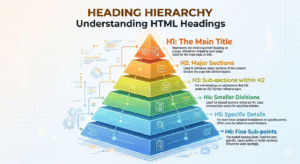
Optimized heading structures make long-form content accessible. Use a single H1 for your primary title, then use H2s and H3s to create a flow of importance. This provides context clues that help Google rank you for multiple queries.
-
H1: The page’s promise (Main Topic).
-
H2: Major sub-questions or steps.
-
H3: Specific sub-topics or details.
Keyword Placement
We use Natural Language Processing (NLP) to avoid “keyword stuffing.” While search engines use formulas like TF*IDF to calculate term frequency, your goal is a unique story. Place target keywords naturally in the H1, the introductory paragraph, and supplementary headers.
Metadata and Descriptive URLs
Your metadata is the “shop window” to your brand. A keyword-optimized meta title is a major ranking factor that boosts your Click-through Rate (CTR). Ensure your titles are specific to the page level and match the language of your content. Manual checks on character length are essential to avoid truncation in search results.
Similarly, use Descriptive, User-Friendly URLs. Avoid non-descriptive identifiers; instead, use categorized subfolders (e.g., /blog/seo-guide) to provide context and help the user navigate. Following this Beginner’s Guide to On-Page SEO in 2026 ensures that every element of your site-even the address bar-is optimized for clarity.
Images, Accessibility, and Speed
Don’t forget to optimize your visual assets. Use short, descriptive filenames and precise Alt text. This not only helps with SEO but is a requirement for accessibility. To maintain high page speed, use next-gen formats like WebP, SVG, or AVIF.
Technical considerations like minification of JavaScript/CSS and Gzip compression improve retention by ensuring fast load times. Note that INP (Interaction to Next Paint) is now a primary metric for measuring visual stability and interactivity.
Technical On-Page: Schema and Canonicals
Structured Data (Schema) makes your content eligible for rich snippets. Use JSON-LD to mark up FAQ pages, products, or articles. This helps AI bots understand the specific details of your content.
For sites with multiple URLs showing similar content, a solid canonical approach is required. Use rel=”canonical” to tell Google which version is the primary URL. This prevents “near-duplicate” issues that force Google to guess which page to index. If you follow these steps correctly, you are setting the foundation where a Google First Page Guaranteed result becomes a much more realistic goal through sheer quality and compliance.
Measuring Success with GSC
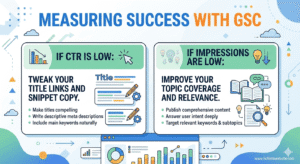
The best way to refine your Beginner’s Guide to On-Page SEO in 2026 strategy is through data. Use Google Search Console (GSC) to track clicks, impressions, and average position.
-
If CTR is low: Tweak your title links and snippet copy.
-
If impressions are low: Improve your topic coverage and relevance.
Common Mistakes to Avoid
-
Ignoring Mobile: If your mobile page hides content found on desktop, your SEO will suffer.
-
JS-Only Links: Ensure your internal links use standard <a href=”…”> tags so they are crawlable.
-
Meta Keywords: These have no impact on ranking; don’t waste your time.
-
Misleading Schema: Ensure your markup exactly matches the visible content on the page to avoid being ineligible for rich results.
By blending technical accuracy with a people-first content strategy, you can master the art of on-page SEO and achieve long-term organic growth.
Frequently Asked Questions (FAQs)
1. What is included in the Beginner’s Guide to On-Page SEO in 2026?
The guide covers content optimisation, title tags, meta descriptions, internal linking, structured data, mobile-first indexing, Core Web Vitals, and proper canonical and noindex management.
2. Is on-page SEO still important in 2026?
Yes. On-page SEO remains the foundation of organic visibility because it directly improves relevance, structure, user experience, and search intent alignment.
3. How does mobile-first indexing affect on-page SEO?
Google primarily evaluates the mobile version of a page for ranking. That means responsive design, fast loading speed, and strong Core Web Vitals are essential.
4. Do meta descriptions impact rankings?
Meta descriptions are not direct ranking factors, but they significantly influence click-through rates by improving how your page appears in search results.
5. How long does it take to see results from on-page SEO?
Improvements can appear within a few weeks after re-crawling, but measurable growth typically takes consistent optimization and monitoring over 1–3 months.