
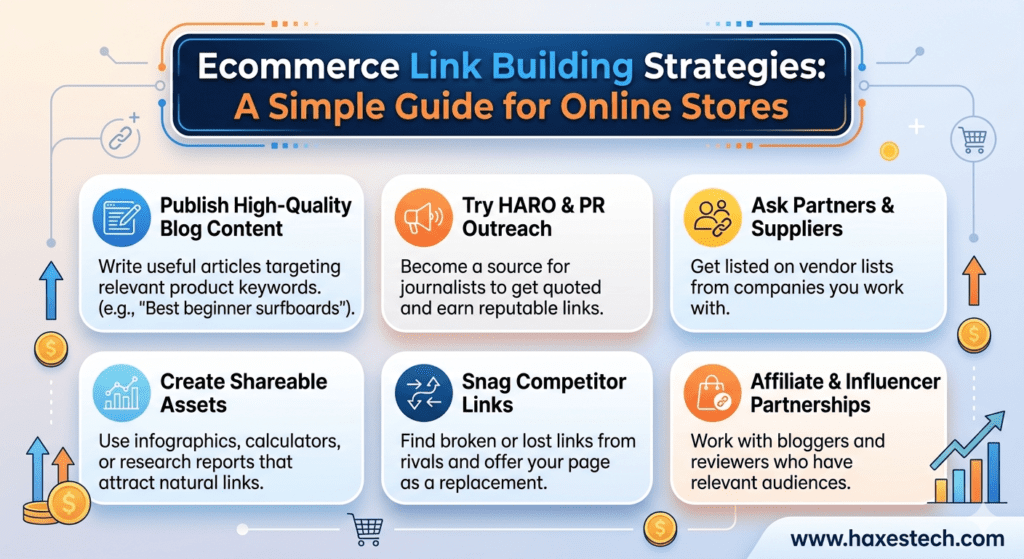
Running a successful online store in 2026 requires much more than just a beautiful website and great products. With millions of shops competing for attention, you need a way to prove to search engines that your business is a leader. This is where ecommerce link building strategies become your most powerful tool.
In simple terms, link building is the process of getting other websites to link to yours. These are called “backlinks.” Think of every backlink as a “vote of confidence.” When a trusted website links to your store, Google sees it as a sign that your business is reliable. This leads to higher rankings, more visitors, and ultimately, more sales.
In this guide, we will break down how you can build a strong backlink profile that helps your store stand out in a crowded digital marketplace.
Why Link Building is the Secret to Ecommerce Growth
For any ecommerce business, appearing on the first page of Google is the goal. Most people never click past the first few results. Backlinks are one of the top three factors Google uses to decide who gets those top spots.
When you invest in a smart link-building plan, you see several big benefits:
-
Higher Search Rankings: Your store moves up for competitive keywords.
-
More Organic Traffic: More people find you through search engines without you paying for ads.
-
Brand Authority: Being mentioned on famous sites makes customers trust you more.
-
Referral Traffic: People clicking those links on other sites come straight to your shop.
As global ecommerce continues to grow, the competition is getting tougher. Using these strategies is no longer optional; it is how you stay in business.
The Unique Challenges of Online Stores
Link building for a shop is harder than link building for a news site or a blog. Online stores face three main hurdles:
-
Changing Products: Items go out of stock or are replaced. If a link points to a deleted product, that link value is lost.
-
The “Salesy” Feel: Most bloggers don’t want to link directly to a “Buy Now” page because it feels like a free advertisement.
-
Technical Issues: Large sites with thousands of categories can be confusing for search engine bots to crawl.
To beat these challenges, smart owners focus on building links to helpful content (like guides) and then use “internal links” to push that power toward their product pages.
Using Blog Content to Attract Links Naturally
One of the best ecommerce link building strategies is starting a high-quality blog. Instead of just asking people to link to a product, give them something useful to link to.
For example, if you sell camping gear, don’t just ask for links to your tents. Instead, write an amazing article titled “The Ultimate Guide to Cold Weather Camping.” People are much more likely to share and link to a helpful guide than a checkout page.
Benefits of a Great Blog:
-
It answers customer questions.
-
It targets “long-tail” keywords (specific phrases people search for).
-
It builds your reputation as an expert in your niche.
How to Get Media Attention with HARO
You don’t always have to go out and find links; sometimes, you can let the links find you. Platforms like HARO (Help A Reporter Out) connect journalists with experts.
Journalists from big magazines often need quotes for their stories. If you sell organic skincare, you can answer a reporter’s question about “natural beauty trends.” If they use your quote, they will usually give you a backlink from a high-authority news site. This is one of the fastest ways to build massive trust with Google.
Creative PR and “Viral” Campaigns
Public Relations (PR) isn’t just for giant corporations. Small ecommerce stores can use creative ideas to get people talking. A unique campaign can earn hundreds of links at once.
Consider these ideas:
-
Data Studies: Release a report on shopping trends in your industry.
-
Seasonal Stories: Create a “Top 10 Gift Guide” for the holidays that news sites want to share.
-
Storytelling: Share a moving story about how your products helped a local community.
When you create something interesting, bloggers and news outlets will want to write about it, giving you high-quality backlinks in the process.
Tapping Into Your Partner and Directory Network
Many store owners forget about the links they can get from people they already work with. These are often the easiest links to get.
Partner Links
If you sell products from famous brands, ask your suppliers or manufacturers to list you as an official retailer on their website. These links are highly relevant and very powerful.
Reputable Directories
List your store in respected directories. If you use Shopify, Magento, or WooCommerce, there are specific directories for stores using those platforms. While you should avoid “spammy” directories, being listed in high-quality, moderated ones helps build your foundation.
Visual Content: The “Shareable” Asset
People love images more than text. Creating visual content is a great way to earn links without even asking.
-
Infographics: Create a chart showing how your product works or a “How-To” visual guide.
-
Statistics: Turn your industry data into an easy-to-read graph.
-
Comparison Tables: Show the difference between different types of products.
When a blogger uses your infographic in their post, they are supposed to link back to you as the source. This is a great way to get “passive” backlinks.
Learning from Your Competitors
You don’t have to reinvent the wheel. By using SEO tools like Ahrefs or Semrush, you can see exactly who is linking to your competitors.
If a popular fashion blog is linking to a competitor’s shoe store, they might be willing to link to yours too. You can reach out to these sites and show them why your store or your latest blog post is even better. This “competitor gap” strategy ensures you aren’t missing out on easy opportunities.
Reaching Out to Resource Pages
Many websites have “Resource Pages” or “Weekly Roundups.” These are pages that list the best products or articles in a specific niche (e.g., “Top 20 Eco-Friendly Shops of 2026”).
To get featured:
-
Find pages that list products similar to yours.
-
Send a polite, personal email.
-
Explain why your store would be a great addition to their list.
Even a few of these placements can significantly boost your traffic.
Turning Brand Mentions into Links
Sometimes, people talk about your store online but forget to add a link. This is called an “unlinked brand mention.”
You can use Google Alerts to see whenever someone mentions your business name. If they didn’t include a link, send a friendly message: “Thanks for mentioning us! Would you mind making our name a clickable link so your readers can find us easily?” Most writers are happy to do this.
Creating “Linkable Assets”
A linkable asset is a specific page on your site designed for one purpose: to get links. This could be:
-
An Online Tool: Like a “Size Calculator” or a “Budget Planner.”
-
A Massive Guide: A 5,000-word “Encyclopedia” of your niche.
-
Original Research: A survey of 1,000 customers about their habits.
These pages provide so much value that other websites feel they must link to them to give their readers the best information.
Collaborating with Influencers
Influencer marketing isn’t just for Instagram likes; it’s great for SEO too. When an influencer reviews your product on their blog, they provide a backlink.
These links are powerful because they come with social proof. If a trusted expert says your product is great, Google notices that trust signal. Focus on “micro-influencers” in your specific niche for the best results and the most honest links.
Tracking Your Success and Scaling Up
Link building is not a one-time job. It is a habit. To see if your strategy is working, you should track:
-
Total Backlinks: Is the number going up?
-
Referring Domains: Are you getting links from new websites?
-
Organic Rankings: Are your target keywords moving toward page one?
-
Sales: Is the increased traffic actually buying products?
Once you find a strategy that works-whether it’s guest posting or infographics-double down on it and do it more often.
Final Thoughts
Effective ecommerce link building strategies are the difference between an invisible store and a market leader. By focusing on providing real value through great content and building honest relationships with other site owners, you will build a website that Google loves.
Don’t look for shortcuts or “black-hat” tricks that might get you banned. Instead, focus on being helpful. When your store genuinely helps people solve their problems, the links-and the rankings-will follow naturally.
FAQs
What is ecommerce link building?
It is the process of getting backlinks to your online store to improve rankings and increase traffic.
Why are backlinks important for ecommerce SEO?
Backlinks build trust and authority, helping your store rank higher in search engines.
Can product pages get backlinks?
Yes, but it is easier to get links through blog content and guides that link to product pages.
How long does link building take to show results?
It usually takes 3 to 6 months to see noticeable improvements in rankings and traffic.
What is the best link building strategy for ecommerce?
Creating valuable content, guest posting, and outreach are the most effective long-term strategies.