

Understanding How to Analyze Your Competitors’ SEO Strategy is one of the smartest ways to improve your website’s visibility on Google. Instead of guessing what works, you can learn directly from businesses that already rank well in search results. By studying their keywords, content, backlinks, and technical setup, you can uncover useful ideas and find opportunities they may have missed. This approach helps you improve your SEO in a practical and data-driven way. As search continues to evolve alongside major industry changes and discussions around SEO Trends to Watch in 2026, learning from competitors has become more important than ever.
Identify Your Real SEO Competitors
The first step is identifying who your real SEO competitors are. These are not always the same companies you compete with offline. In many cases, websites ranking on Google for your important keywords may come from different locations or industries.
Start by searching your main keywords on Google and observing which websites appear in the top results. Look closely at both the organic listings and local results such as the map pack or local 3-pack. If certain businesses appear repeatedly for different keywords, they are likely your main SEO competitors.
SEO tools such as Semrush, Ahrefs, Sistrix, and Moz can help speed up this process. These tools show competitor websites, keyword overlap, and audience similarities. They also help you discover competitors you might not notice through manual searches. By reviewing these insights, you can create a clear list of the competitors you need to analyze.
Study Their Keyword Strategy
After identifying your competitors, the next step is to examine the keywords they rank for. Keywords reveal what type of search traffic is bringing visitors to their websites.
Look at the top-performing keywords that drive traffic to competitor sites. This information shows which topics and search terms are important in your niche. Instead of copying competitors directly, focus on identifying keyword opportunities they might not fully cover.

Keyword gap analysis is especially useful here. It helps you compare your website with competitor sites and find keywords they rank for but you do not. These gaps can reveal new content ideas, potential product topics, or areas where you can compete more effectively.
Long-tail keywords are also worth paying attention to. These longer and more specific search phrases often have lower competition but higher conversion potential.
Analyze Their Content Strategy
Content plays a huge role in SEO success. When analyzing competitors, focus on their best-performing pages rather than individual keywords.
A single strong article or guide can rank for dozens of keywords and bring steady traffic over time. By reviewing competitor pages that attract the most visitors, you can identify common content themes and topics that work well in your industry.
Look at how competitors structure their content. Notice the depth of their articles, the use of images, videos, and multimedia elements, and the overall readability of the page. Sometimes a page ranks simply because no better content exists. In those cases, creating more helpful and detailed content can give you a strong advantage.
Also review the quality of the information they provide. Content that includes real experience, expert insights, and clear explanations tends to perform better than generic content.
Evaluate Their Backlink Profile
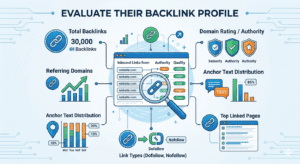
Backlinks remain one of the strongest ranking signals in SEO. These are links from other websites that point to your pages.
By studying competitor backlink profiles, you can see where they earn links and how they build authority online. Tools like Ahrefs or Moz allow you to analyze the number of backlinks, the quality of linking websites, and the anchor text used in those links.
Pay attention to links from news sites, industry blogs, directories, and organizations. These links often carry strong authority and can significantly improve search rankings.
If several competitors receive links from the same website but your site does not, that website could become a potential link opportunity for you as well.
Review Technical SEO Factors
Technical SEO focuses on how well a website functions behind the scenes. Even small technical improvements can influence search rankings.
Look at factors such as website speed, mobile friendliness, and the use of structured data. Competitors may also implement technical improvements that help search engines understand their content more clearly.
Running a technical audit on your own site and comparing it with competitors can reveal areas where your site needs improvement. Sometimes competitors perform better simply because their website loads faster or uses cleaner site architecture.
Check On-Page SEO Elements
On-page SEO includes elements such as title tags, meta descriptions, headings, and internal links. These factors help search engines understand what each page is about.
Review how competitors write their title tags and how they place keywords within them. Well-written titles are clear, engaging, and properly optimized for search intent.
Meta descriptions also play an important role in encouraging users to click on search results. While they may not directly affect rankings, they influence click-through rates.
Look at how competitor websites organize their URLs, internal linking, and page structure. Clear navigation helps both users and search engines find important pages easily.
Another important factor is E-E-A-T, which stands for experience, expertise, authority, and trust. Competitors may highlight these signals through author bios, expert contributions, and fact-checked content.
Use SWOT Analysis to Understand the Competition
After collecting data about competitors, organize your findings with a SWOT analysis. This method focuses on strengths, weaknesses, opportunities, and threats.
For example, one competitor may have strong backlinks but weak content. Another might publish excellent articles but lack technical optimization. By identifying these differences, you can decide where to focus your own efforts.
A realistic approach is important here. Smaller businesses may not compete with large brands in every area, but they can still succeed by focusing on niche topics, unique expertise, and specialized content.

Save Time with Focused Competitor Research
Competitor analysis does not always need to be a long process. If you are working on a specific project, such as launching a new product or writing a new article, you can focus only on the most relevant pages.
Look at the top pages ranking for your target keyword and study their traffic, structure, and content. This quick review can help validate your ideas before investing time in creating new content.
Regularly checking competitor performance is also helpful. Search rankings change often due to algorithm updates, industry changes, and new competitors entering the market.
Turn Competitor Insights into SEO Growth
The real value of competitor analysis comes from using the information you discover. Studying competitor strategies allows you to improve your own website step by step.
By learning what works for top-ranking sites, you can create better content, target smarter keywords, build stronger backlinks, and improve your website’s technical performance. Over time, these improvements can increase organic traffic, strengthen your online presence, and help you outperform competing websites in search results.
When done consistently, How to Analyze Your Competitors’ SEO Strategy becomes a powerful process that helps you make smarter SEO decisions and achieve better rankings on Google.
FAQs
- Why is it important to analyze your competitors’ SEO strategy?
Analyzing your competitors helps you understand what is working in your niche. It reveals keywords, content ideas, and backlinks that can improve your rankings. - What tools can I use to analyze competitors’ SEO strategies?
Popular tools include Ahrefs, Semrush, Moz, and Sistrix. These tools help you study keywords, backlinks, and competitor traffic. - How do I find my SEO competitors?
Search your main keywords on Google and see which websites appear in the top results. These sites are your main SEO competitors. - What should I look for in competitor keyword research?
Focus on the keywords they rank for, their top-performing pages, and keyword gaps where they rank but you don’t.