
If you own a website or a business, you have likely heard people talk about “SEO.” You might be asking yourself: What is SEO? SEO stands for Search Engine Optimization. It helps your website rank higher on Google and other search engines.
Imagine you have a shop in a huge city with millions of other shops. If your shop is hidden in a dark alley, no one will find it. SEO is like putting up bright signs. It ensures the roads lead straight to your door. It tells everyone in town you have what they need. On the internet, SEO makes sure your content isn’t hidden. It helps you reach the people who need it.
More than half of people visit websites by clicking regular search results. Studies show this. This makes SEO one of the most important ways to grow your business in 2026.
How Does SEO Work?
Connecting your website to a person’s search isn’t magic. It is a step-by-step journey that search engines take. To understand SEO, start by learning the four main steps search engines use. These steps help them find and show your website.
- Crawling: The Discovery Phase
Search engines use special computer programs called “crawlers” or “spiders.” Think of these as tiny digital explorers. They travel across the entire internet by clicking on links. They go from one page to another to see what is new. To help spiders find your site, you need a good “map” called a sitemap. You also need links that connect your pages.
- Rendering: Looking at the Page
Once a spider finds your page, the search engine tries to understand what it looks like. It reads the code (like HTML and JavaScript) to see the text, pictures, and layout. It wants to see what a human would see.
- Indexing: The Giant Library
After the search engine reads your page, it stores it in a massive digital library called an “index.” This library holds billions of pages from all over the world. When you type a question into Google, it doesn’t search the entire internet right away. Instead, it checks its own index to find the best answer.
- Ranking: Choosing the Winner
This is the final step. When you search for something, thousands of pages might match. Google uses secret “rules” called algorithms to decide which page is number one, number two, and so on. It looks for pages that are helpful, fast, and easy to read.
To make this work for you, you need a long-term What is SEO plan. You should set clear goals and use tools like Google Search Console to see how many people are finding you.
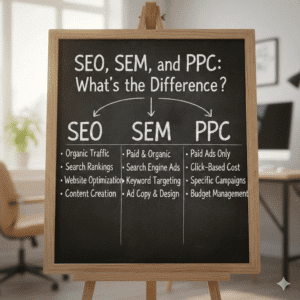
SEO, SEM, and PPC: What’s the Difference?
It can be confusing to hear all these letters like SEM and PPC. Here is an easy way to think about it.
Imagine “Search Engine Marketing” (SEM) is a coin.
- SEO is one side of the coin. It is “organic,” which means you don’t pay for the clicks. You earn your spot by being the best result.
- PPC (Pay-Per-Click) is the other side of the coin. This is when you pay for ads. You bid money so that your website appears at the very top as a “Sponsored” result.
While SEO takes time to grow, PPC works instantly but costs money every time someone clicks. Using both together is a great way to get the best results for your business.
Why is SEO So Important Today?
Every single day, people perform over 8 billion searches. Most of these happen on Google. But the way we search is changing. We don’t type words into a box anymore and We ask our phones questions with our voices. We use cameras to search for objects. Also, we rely on AI tools for quick summaries.
Modern SEO has changed to fit these new habits. Now, your website can show up in different ways, such as:
- Featured Snippets: A small box at the top of Google that answers a question immediately.
- People Also Ask: A list of related questions that help users find more info.
- AI Overviews: These summaries are written by artificial intelligence. They tell users exactly what they need to know.
SEO emphasizes being helpful rather than being seen. Search engines want to send users to websites that load fast. These sites should work well on mobile devices. They also need to be easy to navigate. If your site is frustrating to use, Google will not rank it high.
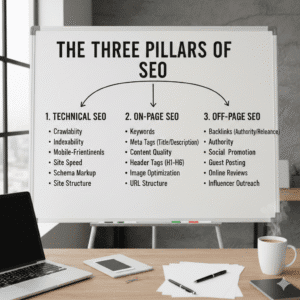
The Three Pillars of SEO
To make your website successful, you need to focus on three main areas. Think of these like a sports team.
- Technical SEO (The Defense)
This is the “under the hood” work. It makes sure that search engines can actually read your site and It means ensuring your site is safe with HTTPS. It also means it needs to load quickly and work well on mobile screens. Since most people now use their phones to search, this is a must-have.
- On-Page SEO (The Offense)
This is about the content on your pages. You want to use “Keyword Optimization.” Use the words people type into Google in your titles and paragraphs. Write clear stories, articles, or product descriptions. They should help readers.
- Off-Page SEO (The Fanbase)
This is about your reputation. Google concludes that your site is of high quality if many other famous and trusted websites link to it.” This is called “Link Building.” You can also build your reputation through social media and by getting good reviews. Using Off-Page SEO Checklists helps you stay organized. They ensure you check your brand mentions and links each month.
Different Types of SEO for Different Jobs
As the internet grows, SEO has become more specialized. Depending on what you do, you might need a specific type:
- Ecommerce SEO: For online shops. It focuses on showing off products and reviews.
- Local SEO: For shops with a physical location, like a pizza place or a hair salon. It helps you show up on Google Maps.
- News SEO: For newspapers and blogs. It focuses on being the first to report a story so it shows up in “Top Stories.”
- International SEO: For businesses that sell to customers in various countries and languages.
How to Start Your SEO Journey
If you are a beginner, don’t feel overwhelmed. You can start with these simple steps:
Step 1: Keyword Research
Find out what your customers are searching for. Use tools to see which words are popular. I suggest looking for “long-tail keywords.” These are longer phrases like “best organic dog food for small puppies” instead of “dog food.” They are easier to rank for because they are more specific.
Step 2: Create Helpful Content
Write for humans first, not robots. Make sure your information is correct and easy to read. Use headings and bullet points to enhance the page’s scannability.
Step 3: Fix the Basics
Ensure your page titles are clear. Also, use “alt text” to describe your images. This helps search engines understand what the pictures display.
Step 4: Build Links
Talk to other people in your industry. Share your content on social media. The more people talk about you, the more Google will trust you.
SEO Never Ends
The most important thing to remember is that What is SEO is not a one-time job. It is an ongoing practice. Google changes its rules often. Your competitors will try to take your spot. Content can become old and “stale.”
To stay at the top, you must keep learning. Use free tools like Google Analytics to see how many people are visiting and what they do on your site. Read blogs like the Beginner’s Guide to SEO and keep an eye on new technology like AI.
By sticking with it, you build a strong foundation for your business. No matter if you’re a small shop or a large company, knowing what SEO is helps you stand out online. It is the best way to ensure that when someone asks a question, your website is the one that provides the answer.
Frequently Asked Questions (FAQs)
- What is SEO and why does it take so long to see results? What is SEO is a long-term strategy, not an instant fix. Unlike paid ads that stop the moment you stop paying, search engines need time to crawl, index, and build trust in your content. Typically, it takes 3 to 6 months to see significant movement in rankings.
- Can I do SEO for my website by myself? Yes! Many small business owners handle the basics by using Off-Page SEO Checklists and following on-page best practices. However, for “Enterprise SEO” or highly competitive niches, many people eventually hire experts to handle the deeper technical architecture.
- Is SEO still relevant with the rise of AI like ChatGPT? Absolutely. While AI changes how we get answers, the core of What is SEO remains the same: providing the most authoritative and helpful content. AI models actually use the same “crawled” data from the web to generate their summaries, making SEO more important than ever.
- What is the difference between internal and external links? Internal links connect different pages on your own website, helping Google understand your site structure. External links (backlinks) are links from other websites to yours; these act as “votes of confidence” that tell search engines your site is trustworthy.