
When you want to grow a business online, you usually hear about two different worlds. One world is Performance Marketing. Here, you pay for each click and hope for quick sales. The other world is SEO, where you work on your website so that search engines like Google show it for free. For a long time, people thought these were separate things. But today, the most successful businesses use something called performance marketing SEO.
This method ensures your free search traffic (SEO) works as hard for your business as your paid ads. It is about moving away from “guessing” and moving toward “knowing.” In this guide, we will break down everything you need to know in very simple terms.
What Is Performance Marketing?
Imagine you have a lemonade stand. You tell a friend, “I will give you $1 for every person you bring to my stand who actually buys a cup.” That is performance marketing. You only pay when you see a result.
In the digital world, this usually involves:
- Search Engine Marketing (SEM): These are the ads you see at the very top of Google.
- Social Media Ads: The “Sponsored” posts you see on Facebook or Instagram.
- Affiliate Marketing: Paying other websites to promote your product.
The goal here is speed. You want clicks, leads (people signing up), and sales right now. It is like a faucet: when you turn the money on, the visitors come. When you turn the money off, the visitors stop.
What Is SEO?
If performance marketing is like a faucet, SEO is like planting an apple tree. It takes time to grow, but eventually, it gives you fruit for free every year.
SEO stands for Search Engine Optimization. Make your website and business pages easy for search engines to read. This includes your Google Business page. The goal is to get visibility in the organic search engine results—the listings that aren’t ads.
To do this well, you need to focus on a few simple steps:
- Keyword Research: Discover what words your audience uses in the search bar.
- On-page Website Optimization: Make sure your words match what people want. This is content optimization.
- Technical Website Optimization: Make sure your site loads fast. It should also work well on mobile devices.
- Local SEO: Making sure people in your neighborhood can find you.
How Do You Optimize a Website for Local SEO?
Many small business owners ask: How Do You Optimize a Website for Local SEO? This is a very important part of a performance marketing SEO plan if you have a physical shop.
To do this, follow these steps:
- Claim your Google Business Profile: This is the box that shows up on Google Maps. Fill out your phone number, address, and hours with accuracy.
- Use Local Keywords: If you’re a plumber in London, say “Plumber in London” on your website, not “Plumber.”
- Get Reviews: Ask your happy customers to leave a review on Google. This tells Google that people trust you.
- **Mobile-Friendly Design:** Many folks search for local businesses on their phones. They often do this while walking or driving. If your site doesn’t look good on a phone, they will leave.
Why Performance Marketing SEO Matters
The reason we combine these two is simple: Business Results.
In the past, people did SEO to “rank #1.” But ranking #1 doesn’t matter if no one buys anything. By using a “performance” mindset, we look at SEO performance metrics. These are the numbers that tell us if our hard work is actually making money.
Without an SEO performance report, you are “flying blind.” You might see that you have a lot of traffic, but you won’t know if that traffic is turning into revenue. Tracking SEO success metrics helps us see how search engines and users interact. We can understand their behavior on the site.
The 15 Key Metrics You Should Track
Keep an eye on these 15 numbers. They are key to a successful performance marketing SEO strategy. Don’t worry, they are easier to understand than they sound:
- Organic Traffic: How many people found your site through free search?
- Keyword Rankings: Where your site shows up (Page 1? Page 10?) for specific words.
- Search Visibility: This is the share of people who see your brand when they search for your industry.
- Click-Through Rate (CTR): Out of 100 people who saw your link, how many actually clicked it?
- Organic Conversions: How many people who discovered you for free made a buy or signed up?
- Domain Authority: A score that shows how much Google trusts your website.
- Backlinks: How many other websites are “voting” for you by linking to your site.
- Referring Domains: How many different websites link to you.
- Indexed Pages: How many pages of your site does Google actually know about?
- Core Web Vitals: A fancy way of saying “Is your site fast and easy to use?”
- Organic Impressions: How many times your site appeared on a screen, even if no one clicked.
- Share of Voice: Are you seen more often than your competitors?
- Crawl Errors: Is Google having trouble reading your site?
- Organic Revenue: Exactly how much money did you make from free search?
- Returning Visitors: Do people like your content enough to come back again?
The Differences and Similarities
It is helpful to see how these two worlds compare:
Feature
- Performance Marketing (Ads)
- Time Frame: Short-term (Instant)
- Cost: Pay-per-click
- Sustainability: Stops when you stop paying
- Goal: Immediate Sales
SEO (Organic)
- Time Frame: Long-term (Months)
- Cost: Free clicks (but costs time/work)
- Sustainability: Keeps growing over time
- Goal: Awareness and Trust
Even though they are different, they use the same digital marketing metrics. Both care about impressions, clicks, and traffic. When users click an ad or an organic listing, you want them to enjoy a great experience. This helps turn them into customers.
How SEO Helps Your Paid Ads
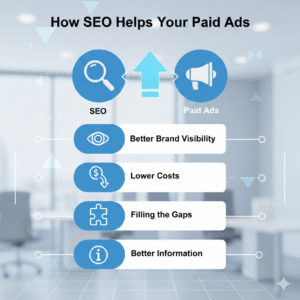
The smartest business owners use SEO to make their paid ads cheaper. This is the heart of performance marketing SEO.
- Better Brand Visibility: People who read your blog today will click your ad tomorrow. This happens because they recognize your business name.
- Lower Costs: Some keywords are very expensive to buy ads for. If you can rank for those words for free using SEO, you can save your budget for other things.
- Filling the Gaps: SEO helps you discover “non-branded” terms. These are words that don’t have your company name. They can attract new visitors who haven’t heard of you before.
- Better Information: Check which SEO pages keep people engaged. This shows what your audience cares about. You can then use that same language in your ads to get more leads.
Using Tools to Save Time
You don’t have to do all this by hand. In the past, people used spreadsheets and manual checks, but that takes too long. Today, we use SEO automation tools. These tools can:
- Check your ranks every day without manual input.
- Find broken links or technical website errors.
- Automate SEO reports to show your stakeholders how much money you’re making.
Summary: The Path to Success
To succeed in performance marketing SEO, stop seeing it as a “bonus.” Think of it as a key engine for growth.
Start by fixing your technical website optimization so the site is fast. Move on to keyword research to understand your users. Create great content that answers their questions. Track SEO performance. This helps make sure your efforts lead to real business results.
Quick marketing and strong SEO boost your business and set industry standards.
Frequently Asked Questions (FAQs)
Q1. What is performance marketing SEO?
Performance marketing SEO is an approach where SEO efforts are measured using clear performance metrics like traffic, leads, conversions, and revenue to ensure real business results.
Q2. How is performance marketing SEO different from traditional SEO?
Traditional SEO focuses mainly on rankings, while performance marketing SEO connects rankings with measurable outcomes such as clicks, leads, and sales.
Q3. Is performance marketing SEO better than paid marketing?
Performance marketing SEO is more sustainable because it delivers long-term organic traffic, whereas paid marketing stops generating results when the budget ends.
Q4. Which metrics are important in performance marketing SEO?
Key metrics include organic traffic, keyword rankings, click-through rate (CTR), conversions, user engagement, and revenue from organic search.
Q5. Can performance marketing SEO improve ROI?
Yes, by tracking results and optimizing based on data, performance marketing SEO helps reduce wasted effort and improves overall return on investment.
Q6. How long does performance marketing SEO take to show results?
Unlike paid ads, performance marketing SEO usually takes time, but once results appear, they continue to deliver value over the long term.