
In digital marketing, a brand connects with its audience through visibility. This On-Page SEO Guide is your key to improving individual webpages. It helps you stand out in search engine results and AI-generated answers. Many marketers emphasize Cutting-Edge Off-Page SEO Techniques to boost external authority. But the real strength of a digital strategy is in what you can control on your own site. Make your webpage both accurate and relatable. This will help it attract algorithms and real users alike.
Understanding On-Page Content and SEO
On-page content is the living soul of your website. It’s not a wall of text. It’s a mix of words, images, videos, and interactive features for a full experience. To rank well, you must balance readability and what search engines understand. When you make structured assets that fit search intent, you do more than add content. You also improve user experience. You’re improving user experience. You’re solving a real human need.
To truly master this discipline, you must view it as the art of refining webpages for clarity. This On-Page SEO Guide helps you get relevant traffic without a big agency. It focuses on specific tools that you can use with great effectiveness. Focus on the “big three” – search intent, title tags, and meta descriptions. This creates a clear roadmap for users to follow.
On-Page SEO vs. Off-Page SEO: Knowing the Difference
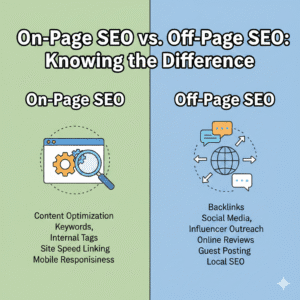
The primary distinction between on-page and off-page SEO lies in the “where” and the “how.”
- On-Page SEO: This includes tasks that you carry out within your webpage. You have complete control over these factors. This includes keyword placement. It also covers HTML formatting and site speed.
- Off-Page SEO: This includes tasks done outside your site to improve its reputation. Examples are link building, social media marketing, and digital public relations.
Chasing backlinks can show authority, but your internal SEO strategy is key. It helps users find what they need once they land on your site. Optimizing image alt text, refining URL slugs, and using schema markup are key steps. They help your site stand out from the competition.
The Foundation: Keyword Research and Strategic Placement
Everything in this On-Page SEO Guide begins with keyword research. To understand your audience better, go beyond popular terms. Find “high-value” keywords -these are the phrases people use when they’re ready to act.
Success Achieved in Specific Geographic Areas
For businesses aiming for local growth, integrating local SEO is a game-changer. A skincare brand, for example, shouldn’t fight for the term “skincare.” Focus on long-tail queries. Use phrases like “best natural cleansers in London.” Try “organic moisturizers for dry skin.” This detail can turn a basic page into a magnet for qualified leads.
Strategic Keyword Integration
Once you have your keywords, place them where they matter most for search crawlers:
- H1 Heading: The primary title of your page.
- First Paragraph: To establish context immediately.
- Subheadings (H2, H3): To maintain topical relevance throughout the scroll.
- URL Slug: To keep the address short and descriptive.
- Image Alt Text: To describe visual content to search engines and assistive technologies.
Crafting High-Quality, User-Focused Content
Content is the “backbone” of your SEO campaign. True excellence in this area thrives on storytelling that addresses specific needs. This approach creates a “resonance” that keeps visitors on the site longer. This lowers bounce rates and improves engagement metrics.
To produce content that ranks, you must provide a thorough exploration of your niche. The Keyword Strategy Builder helps you group terms. It organizes them into logical clusters. Don’t keyword stuff. Instead, share unique insights, data, and visuals. This approach meets the needs of both people and AI tools like Perplexity or ChatGPT.
The Technical Pillars: Metadata and Hierarchy
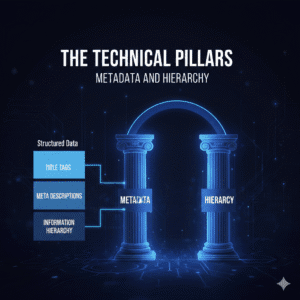
Content brings value, but metadata announces your arrival.
Title Tags
Your title tag is your HTML page title. It’s the first thing a user sees in browser tabs and search results. To prevent truncation (cutting off the text), keep your title between 50–60 characters. Always place your primary keyword near the beginning to maximize its weight.
Meta Descriptions
The meta description is a concise summary that acts as a “clickable headline.” A good description boosts your Click-Through Rate (CTR). Use active voice and a clear Call to Action (CTA) for the best results.
Information Hierarchy
Proper use of Headers (H1, H2, H3) is essential for structuring quality content. This sets up a visual hierarchy. It helps improve readability. Also, it lets AI systems grab featured snippets or direct answers from your text.
User Experience (UX) and the Mobile-First World
In modern SEO, User Experience and rankings have a profound connection. Dwell time and accessibility measure a seamless experience. Today, we live in a mobile-first world. Google mainly looks at your site’s mobile version for indexing and ranking.
Performance Optimization
High rankings are impossible with slow-loading pages. To ensure a superior landing page experience, you should:
- Compress Images: Use formats like WebP to maintain quality at a lower file size.
- Browser Caching: To speed up load times for returning visitors.
- Cut Redirects: To reduce the “handshake” time between the server and the user.
- CDN Usage: Use Content Delivery Networks to deliver content quickly in different locations.
The Architecture of Linking: Internal and External
I often see internal linking mistakes ruin an otherwise perfect site structure. Internal links guide users and search engines to find related pages. Linking high-authority “cornerstone” content helps spread “link juice.” This connects to product pages and blog posts. This also boosts session duration.
External linking holds equal importance. Pointing your readers toward authoritative, high-quality sources builds trust and provides extra value. It shows search engines that your content is part of a bigger, well-researched network.
Advanced On-Page Tactics: Schema and AI Optimization
To take your site beyond the basics, you must embrace advanced technical SEO.
- Schema Markup: This structured data helps you get “rich snippets.” These are the extra details, like star ratings, prices, or FAQ sections that show up in the SERPs.
- LLM-Focused Optimization: As AI takes the lead in search, ensure your content is easy to “parse.” Use numbered lists, clear stats, and straightforward paragraphs. This helps AI tools cite your work easily.
- Core Web Vitals: Pay attention to “Largest Contentful Paint” (LCP). This helps your main content load on time.
Measuring Success: The Final Piece of the Puzzle
An On-Page SEO Guide is only as good as the results it produces. Track your success with tools like Google Analytics 4 (GA4) and Google Search Console.
Check the following metrics:
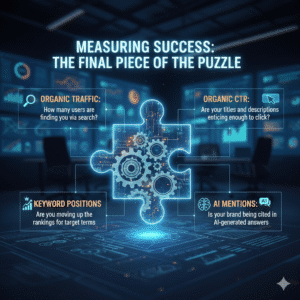
- Organic Traffic: How many users are finding you via search?
- Organic CTR: Are your titles and descriptions enticing enough to click?
- Keyword Positions: Are you moving up the rankings for your target terms?
- AI Mentions: Is your brand being cited in AI-generated answers?
Final Thoughts
Successful on-page SEO combines technical precision with creative storytelling. Focusing on your audience instead of the algorithm boosts your search rankings. This approach makes webpages powerful tools for digital success. No matter if you’re a small business or a big company. Mastering these pillars can boost your online potential.
The digital world will keep evolving, but key principles will stay the same. Providing value, maintaining speed, and ensuring clarity will always be the gold standard.
Frequently Asked Questions (FAQs)
Q1: What is on-page SEO?
A: On-page SEO refers to the tasks performed on a webpage to improve its search engine rankings. It includes optimizing content, meta tags, headers, internal links, images, URL slugs, page speed, and mobile usability to match search intent and enhance user experience.
Q2: Why is on-page SEO important for AI and search engines?
A: On-page SEO helps search engines and AI systems like LLMs understand your content, match relevant queries, improve visibility, and drive qualified traffic. Optimized content signals relevance and provides better user engagement, indirectly boosting rankings.
Q3: How do I optimize meta titles and descriptions?
A: Title tags should include the target keyword, be between 50–60 characters, and clearly indicate the page topic. Meta descriptions should be around 105 characters, match search intent, and include a call-to-action to encourage clicks from search results.
Q4: What role do internal links play in on-page SEO?
A: Internal links connect related pages, guide users through your site, improve navigation, and help search engines understand your content hierarchy. Use descriptive anchor text, link to high-priority pages, and avoid over-linking to maintain relevance.
Q5: How can I optimize images for SEO?
A: Use descriptive alt text, optimize file sizes for faster page load, choose appropriate formats (WebP, PNG, SVG), specify image dimensions, and implement lazy loading. Proper image SEO improves accessibility, page speed, and search visibility.
Q6: Can I do on-page SEO myself without hiring an agency?
A: Absolutely. By following a structured On-Page SEO Guide, you can optimize content, titles, meta descriptions, images, page speed, mobile experience, and internal links yourself using tools like On Page SEO Checker, Google Analytics 4, and Semrush.
Q7: How do I measure the success of my on-page SEO efforts?
A: Track key metrics like organic traffic, keyword rankings, CTR, dwell time, and SERP feature appearances using Google Analytics, Google Search Console, and Semrush Position Tracking. Additionally, monitor AI mentions using tools like Semrush AI Visibility Toolkit to gauge your content’s visibility in AI-generated responses.